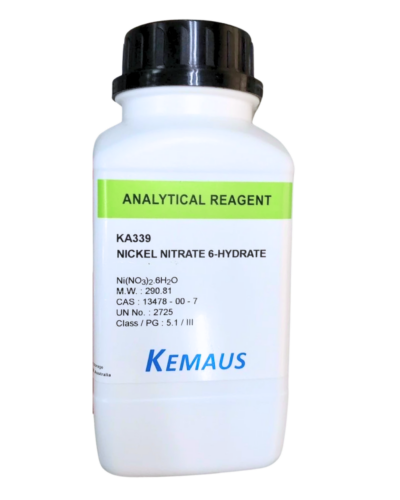
Nickel nitrate hexahydrate (Nickeous nitrate)
Product Overview & Quality
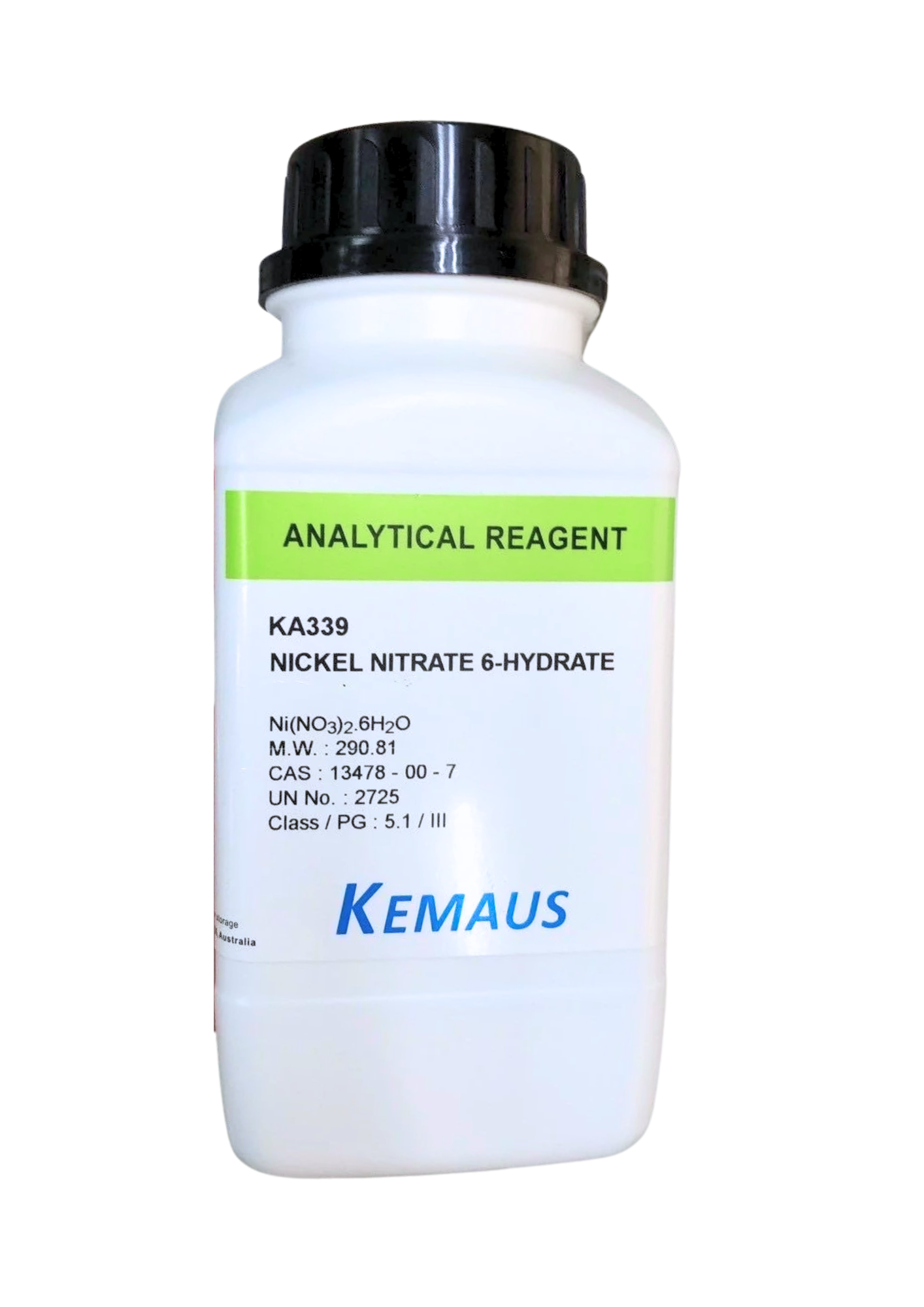
- Product Name: Nickel nitrate hexahydrate (Nickeous nitrate)
- Brand: Kemaus (Product Code: KA-339)
- Grade: Analytical Reagent (AR Grade) with a premium purity of 99 percent or higher. Rigorously manufactured and verified under Kemaus strict laboratory quality control standards. It guarantees exceptionally low trace levels of foreign heavy metals, chlorides, and sulfates, ensuring absolute reliability, maximum sensitivity, and clean baselines for quantitative chemical matrices.
- Physical Properties: Odorless, brilliant emerald-green crystals or crystalline lumps. It is highly deliquescent and liquefies readily upon atmospheric moisture exposure.
- Solubility: Extremely and rapidly soluble in water, yielding a clear green solution; readily soluble in alcohol and ethanol. Yields a mildly acidic aqueous solution.
- Key Use: Heavily utilized as a primary compound and stock standard solution for calibrating atomic absorption spectrometers (AAS) and ICP systems. Commonly applied as a premium electrolyte baseline in electrochemical laboratories for nickel electroplating research and advanced battery cell formulations. Functions as an essential precursor for synthesizing nickel-based catalysts used in organic chemical reactions, and applied in materials science for coordination chemistry and complexation assays.
Safety & Hazards (Critical & Hazardous)
- Classification: May intensify fire; oxidizer. May cause cancer by inhalation (Carcinogen). Harmful if swallowed. Harmful if inhaled. Causes skin irritation. Causes serious eye damage. May cause an allergic skin reaction. May cause allergy or asthma symptoms or breathing difficulties if inhaled. Suspected of causing genetic defects. May damage fertility or the unborn child. Very toxic to aquatic life with long-lasting effects.
- Health Risks: Direct eye contact triggers immediate severe stinging irritation, tissue tearing, and corneal redness. Skin contact causes localization irritation and severe dermal sensitization (Nickel dermatitis). Inhalation of fine airborne dust aggressively damages pulmonary tissues, inducing acute coughing, wheezing, and chronic respiratory risk.
- First Aid Measures: Flush affected eyes or skin immediately with plenty of flowing water for at least 15 minutes while removing contaminated garments. Seek prompt emergency medical evaluation immediately.
Handling & Storage
- Storage: Strong Oxidizer and Highly Deliquescent. It readily liquefies in humid conditions and can accelerate the combustion of surrounding materials. Must be stored in its original, tightly sealed Kemaus container inside a dedicated chemical safety cabinet for oxidizers. Keep in a cool, strictly dry, and well-ventilated dedicated space at stable room temperature (below 30 degrees Celsius). Keep completely isolated from combustible materials, organic solvents, reducing agents, and strong acids.
- Precautions: Comprehensive specialized PPE is mandatory, including chemical-resistant laboratory gloves, protective safety goggles, a lab coat, and a fine particulate dust respirator. Handle exclusively within a functioning laboratory fume hood to avoid accidental exposure or dust inhalation.