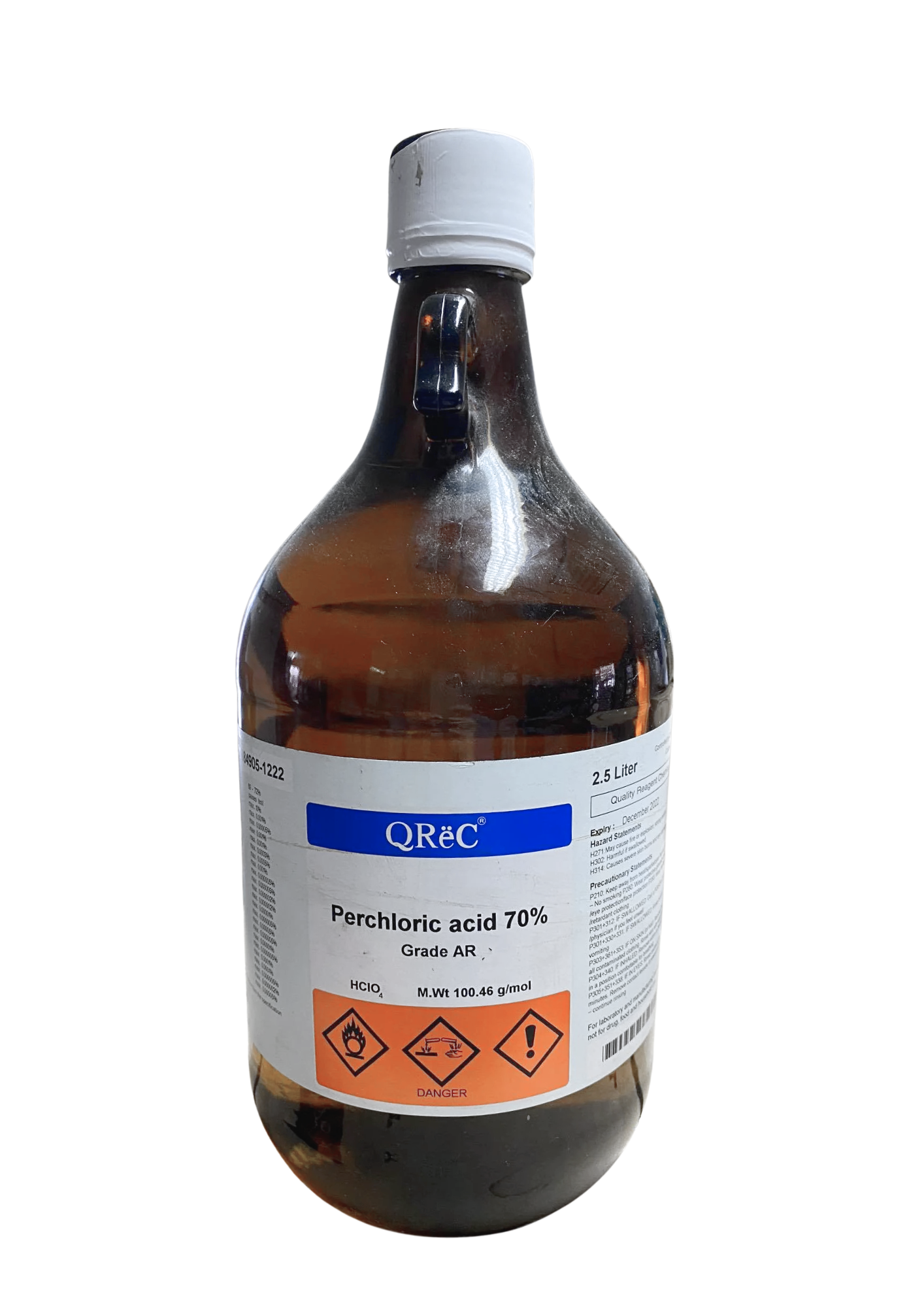
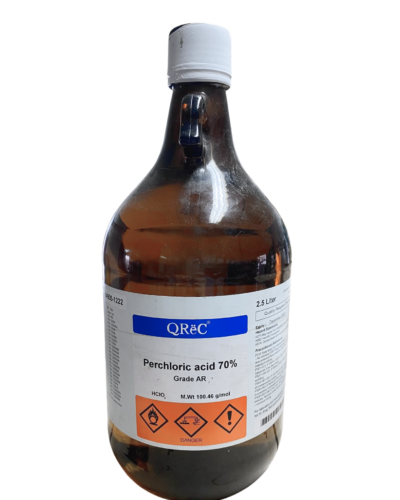
Perchloric acid 70%
Product Overview & Quality
- Product Name: Perchloric acid 70%
- Brand: QReC (Product Code: QR-P1005-1-2501)
- Grade: Analytical Reagent (AR Grade) featuring a certified nominal assay range of 69 to 72 percent (weight/weight). Produced and quality-monitored under strict QReC global laboratory specifications. Rigorously analyzed to enforce exceptionally low ppm thresholds of chlorides, sulfates, nitrates, silicates, phosphates, and trace heavy metals (such as iron, lead, copper, and nickel). This high chemical purity minimizes background spectral noise and ensures reliable digestion baselines in trace elemental quantification. Packaged in a heavy-duty, chemically resistant glass bottle engineered for hazardous chemical containment.
- Physical Properties: Clear, colorless, slightly viscous liquid that produces faint white fumes in moist air. Odorless to faintly pungent. Extremely strong mineral superacid; acts as an exceedingly violent oxidizing agent at elevated temperatures.
- Solubility: Completely miscible in all proportions with water (highly exothermic reaction upon dilution).
- Key Use: Heavily utilized as an authoritative wet digestion reagent (typically combined with concentrated nitric acid) for digesting complex and refractory matrices, including ores, biological tissues, geological samples, polymers, and agricultural products prior to spectroscopic analysis (AAS, ICP-OES, and ICP-MS). Universally applied as a primary volumetric titrant in non-aqueous acid-base titrations to quantify weakly basic pharmaceuticals, alkaloids, vitamins, and amino acids. Commonly employed in advanced inorganic synthesis for preparing high-purity perchlorate compounds and serves as an electrolyte medium in electrochemical electropolishing of metals.
Safety & Hazards (Critical, Severe Oxidizer, Corrosive & Explosive)
- Classification: May cause or intensify fire; oxidizer (Category 1). Corrosive to metals. Harmful if swallowed. Causes severe skin burns and eye damage. Causes serious eye damage.
- Health Risks: Direct eye contact causes catastrophic necrotic destruction of corneal and conjunctival tissue, resulting in instantaneous permanent blindness. Dermal exposure produces deep, penetrating caustic burns with rapid tissue liquefaction, severe ulceration, and systemic shock. Inhalation of corrosive acidic mists violently attacks the mucous membranes of the respiratory tract, provoking acute bronchospasms, chemical burns, pulmonary edema, and potential fatality. Ingestion leads to severe perforation of the mouth, esophagus, and gastrointestinal tract.
- Explosion Hazard: When heated or concentrated, perchloric acid acts as a violent oxidizer that explodes violently upon contact with organic matter, solvents, reducing agents, or combustible materials. Fumes migrating into standard laboratory exhaust ducts can form shock-sensitive heavy metal and organic perchlorate salts that can detonate unpredictably under physical friction or vibration.
- First Aid Measures: Immediately flush affected eyes or skin with an abundant stream of clean flowing water for at least 20 minutes while stripping contaminated garments. In case of vapor inhalation, rapidly relocate the victim to fresh air. If accidentally swallowed, do NOT induce vomiting; thoroughly rinse mouth, administer water if conscious, and seek immediate, urgent emergency medical treatment.
Handling & Storage
- Storage: Powerful Oxidizer and Severe Explosion Risk. Must be stored in its original, tightly closed QReC glass bottle placed on inert secondary containment trays (glass or ceramic; strictly avoid wooden or combustible surfaces). Keep in a dedicated, cool, dry, and excellently ventilated chemical store at controlled temperatures (below 25 degrees Celsius), sheltered from direct sunlight. Keep completely segregated and isolated from organic chemicals, solvents, alcohols, grease, paper, cloth, wood, reducing agents, and combustible materials.
- Precautions: Full specialized PPE is mandatory, including heavy acid-resistant gloves, a full-face safety shield paired with splash goggles, and an impervious chemical apron. Heating or evaporating perchloric acid must be conducted exclusively within a certified Perchloric Acid Fume Hood equipped with an integrated water wash-down system to prevent explosive perchlorate salt buildup in ductwork. Never handle in general-purpose exhaust hoods.