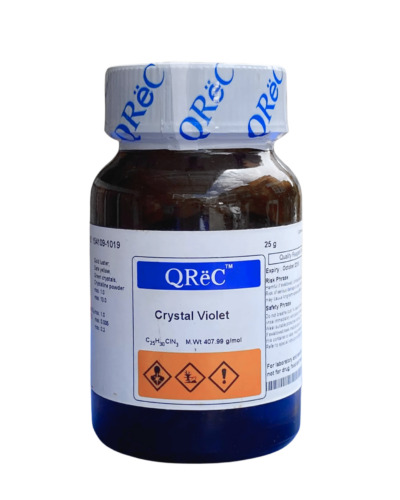
Crystal violet or Gentian violet or C.I. Basic Violet 3 or Hexamethylpararosaniline chloride
Product Overview & Quality
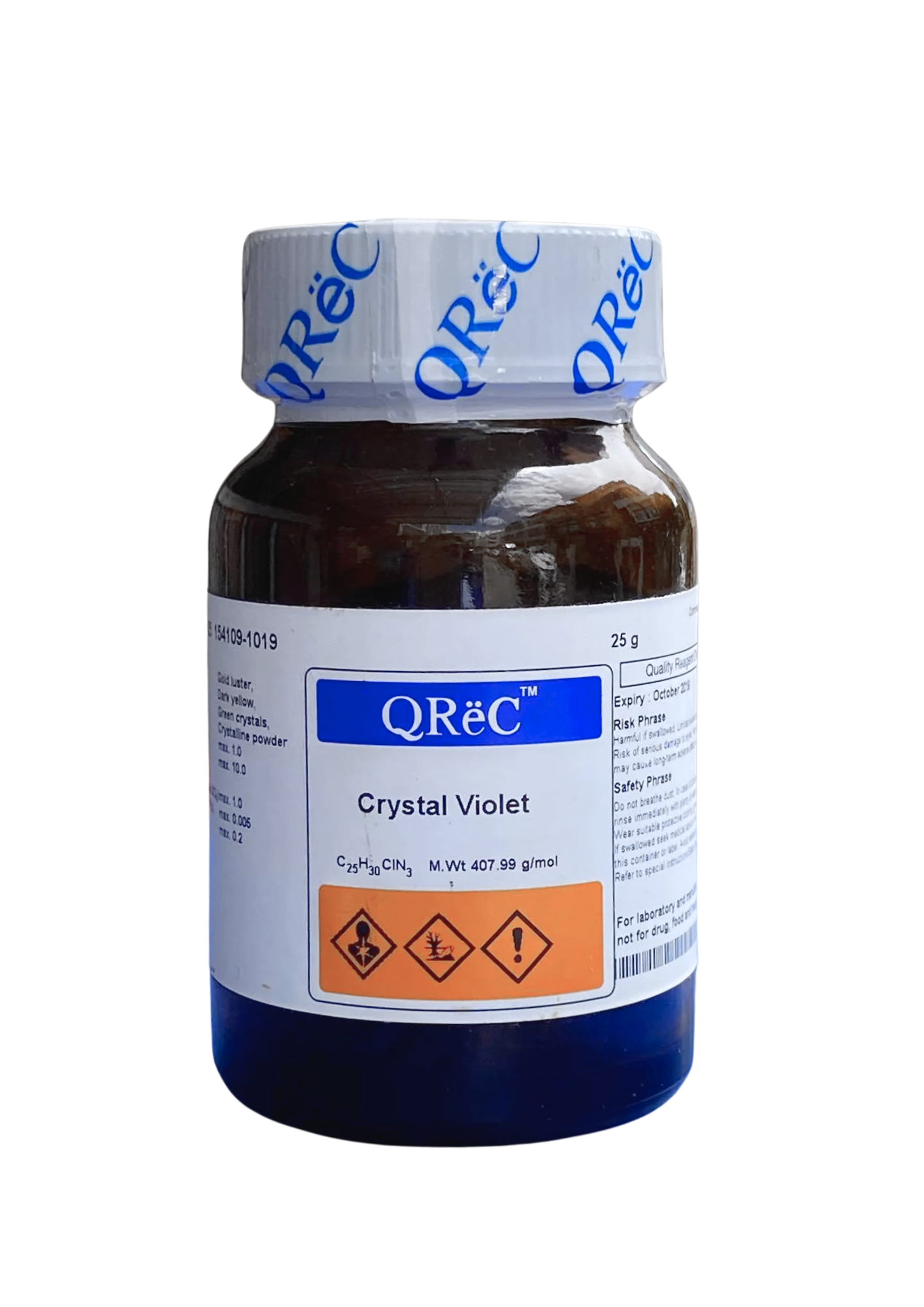
- Product Name: Crystal violet or Gentian violet or C.I. Basic Violet 3 or Hexamethylpararosaniline chloride
- Brand: QReC (Product Code: QR-C6009-0-0025)
- Grade: Analytical Reagent / Certified Biological Stain Grade (AR Grade) featuring a high certified dye content of not less than 90 to 96 percent. Manufactured and standardized under strict QReC global laboratory specifications. Rigorously analyzed to enforce ultra-low ppm thresholds of sulfated ash, moisture, ethanol-insoluble residue, and trace heavy metals (such as lead, arsenic, iron, and zinc). Certified for high-fidelity cellular affinity, delivering intense, uniform, and sharp chromatic resolution without particulate background precipitation. Packaged in a heavy-duty amber glass bottle for maximum chemical integrity and light protection.
- Physical Properties: Dark green crystalline powder with a shiny metallic bronze-green luster. Odorless. Dissolves in water and alcohol to generate an intense, vivid deep blue-violet solution. Non-combustible solid under normal laboratory conditions.
- Solubility: Moderately soluble in water (approximately 1.6 grams per 100 milliliters at room temperature; solubility escalates substantially in boiling water); freely soluble in ethanol, methanol, glycerol, and chloroform; practically insoluble in diethyl ether.
- Color Transition Interval (pH Range): Functions as a specialized visual pH indicator operating across the pH range of 0.0 to 2.0. Exhibits a distinct yellow color in extremely strong acidic conditions, transitions through green, and shifts to a vivid blue-violet in weakly acidic, neutral, and alkaline environments.
- Key Use: Universally utilized as the definitive primary stain in the Gram staining protocol in diagnostic microbiology and pathology, selectively staining Gram-positive bacterial cell walls a distinctive deep purple. Widely employed as a nuclear and chromosomal stain in cytology, histology, and plant somatic cell division studies. Standardly used in vitro for cell viability, colony formation, and cytotoxicity quantification assays (Crystal violet assay) in cancer biology. Applied as a sharp visual indicator in non-aqueous titrations (paired with standard perchloric acid in glacial acetic acid) for quantifying organic weak bases and active pharmaceutical ingredients. Serves as a selective bacteriostatic inhibitor against Gram-positive organisms in specialized culture media (such as MacConkey agar).
Safety & Hazards (Critical, Carcinogen, Serious Eye Damage & Aquatic Toxic)
- Classification: May cause cancer. Suspected of causing genetic defects. Suspected of damaging fertility or the unborn child. Causes serious eye damage. Harmful if swallowed. Very toxic to aquatic life with long lasting effects.
- Health Risks: Direct ocular contact causes instantaneous, severe caustic ulceration of the cornea and conjunctiva, resulting in intense pain, corneal opacification, and permanent vision impairment. Dermal contact induces localized erythema, dermatitis, and produces persistent, indelible deep violet stains on the skin. Inhalation of airborne particulate dust severely irritates mucous membranes of the respiratory tract, inducing coughing, sneezing, and dyspnea. Ingestion causes gastrointestinal erosion, violent abdominal pain, vomiting, diarrhea, systemic toxic symptoms, and potential hepatic or renal damage. Chronic occupational exposure is clinically established as a potent carcinogenic and mutagenic hazard.
- First Aid Measures: Immediately flush affected eyes with an abundant stream of clean flowing water for at least 15 to 20 minutes while stripping contaminated clothing. In case of dust inhalation, rapidly relocate the victim to fresh air. If accidentally swallowed, thoroughly rinse mouth with water, drink water, and seek immediate, urgent emergency medical attention, alerting clinical staff to triphenylmethane dye exposure.
Handling & Storage
- Storage: Carcinogenic Hazard and Light-Sensitive Biological Dye. Photodegradable upon extended radiation exposure. Must be preserved in its original, tightly sealed QReC amber glass bottle. Store in a dedicated, securely locked hazardous chemical cabinet with restricted access. Keep in a cool, dry, dark, and excellently ventilated chemical store at controlled temperatures (below 25 to 30 degrees Celsius), sheltered from direct sunlight. Keep strictly segregated from strong oxidizing agents, strong mineral acids, and strong reducing agents.
- Precautions: Comprehensive specialized PPE is mandatory, including chemical-resistant nitrile gloves, splash-proof safety goggles, a particulate respirator (N95 or HEPA), and a protective lab coat. Weighing, dispensing, and reagent preparation must be performed strictly and exclusively within a properly functioning laboratory fume hood to avoid airborne particulate exposure and persistent lab contamination. Never discharge dye-containing residues into municipal drains; collect exclusively in dedicated hazardous waste containers for certified disposal.