Hydrogen peroxide 35% or Hydrogen dioxide
Product Overview & Quality
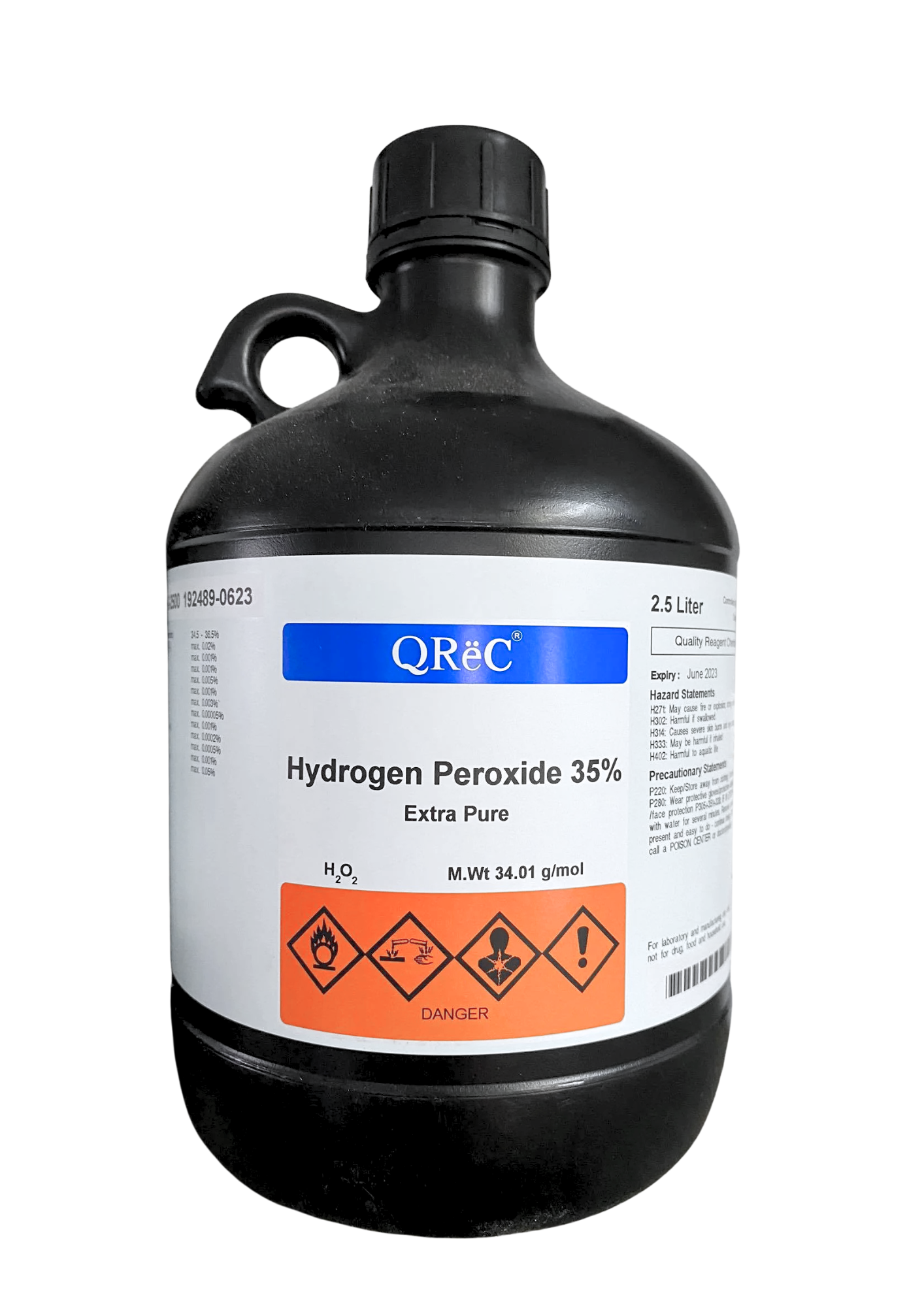
- Product Name: Hydrogen peroxide 35% or Hydrogen dioxide
- Brand: QReC (Product Code: QR-H8089-3-2500)
- Grade: Analytical / Laboratory Grade featuring a certified nominal assay of not less than 35 percent (weight/weight). Produced and quality-monitored under QReC global laboratory standards to enforce exceptionally low ppm thresholds of non-volatile matter, free acids, chlorides, sulfates, phosphates, and transition metal catalysts (such as iron, copper, lead, and nickel). Its concentrated formulation delivers amplified oxidative potency for challenging analytical matrices while maintaining chemical stability. Packaged in a heavy-duty, opaque plastic container fitted with an engineered pressure-relieving vented cap to safely prevent internal oxygen over-pressurization.
- Physical Properties: Clear, colorless, mobile liquid with a slightly higher density and viscosity than water; faint, irritating, sharp odor. Non-combustible alone, but acts as a powerful oxidizer that drastically accelerates the combustion and potential detonation of flammable and combustible matter.
- Solubility: Completely miscible in all proportions with water; soluble in select polar organic solvents under strictly controlled, diluted, and low-temperature parameters.
- Key Use: Heavily utilized as a powerful oxidizing agent for advanced wet chemical mineralization and sample digestion, frequently paired with concentrated mineral acids for breaking down resistant organic matrices prior to trace metal spectroscopic analysis. Extensively applied in organic and inorganic synthesis for high-yield, selective epoxidation and oxidation pathways. Widely used in advanced wastewater remediation research utilizing advanced oxidation processes (AOPs) and Fenton oxidation mechanisms. Serves as an effective high-strength bleaching agent in specialized paper, textile, and biomaterial research.
Safety & Hazards (Critical & Strong Oxidizer)
- Classification: Oxidizing liquid. Harmful if swallowed. Harmful if inhaled. Causes severe skin burns and eye damage. Causes serious eye damage. Harmful to aquatic life.
- Health Risks: Direct ocular contact causes immediate and catastrophic chemical burns, complete corneal necrosis, and irreversible blindness. Dermal exposure results in instant, severe skin bleaching necrosis accompanied by acute caustic burning sensations and deep tissue ulceration. Inhalation of concentrated vapors or aerosol mists violently corrodes the mucous membranes of the respiratory tract, provoking coughing, severe dyspnea, chemical pneumonitis, and life-threatening pulmonary edema. Ingestion causes destructive caustic erosion of the mouth, esophagus, and stomach, coupled with rapid gaseous oxygen generation that risks fatal internal gastric rupture.
- First Aid Measures: Immediately flush exposed eyes or skin with abundant running water for at least 15 to 20 minutes while stripping all contaminated clothing. In case of inhalation, rapidly relocate the victim to fresh air. If accidentally swallowed, do NOT induce vomiting; thoroughly rinse mouth, administer water if conscious, and seek immediate, urgent emergency medical treatment.
Handling & Storage
- Storage: Powerful Oxidizer, Highly Heat– and Light-Sensitive Formulation. Concentrated 35 percent solutions are subject to rapid exothermic decomposition into water and oxygen gas when exposed to heat, UV light, or particulate matter. Must be stored in its original, vented QReC container maintained in an upright orientation. Keep in a dedicated, dark, cool, and well-ventilated chemical store at controlled temperatures (ideally below 25 degrees Celsius). Keep completely segregated from combustible materials, organic solvents, metal powders, strong acids, strong alkalis, reducing agents, and airborne contaminants.
- Precautions: Comprehensive specialized PPE is mandatory, including heavy-duty chemical-resistant gloves, a full-face safety shield paired with splash goggles, and an impervious protective apron or lab coat. Never return unused aliquots back into the primary stock container to eliminate contamination-triggered pressurized failure hazards.