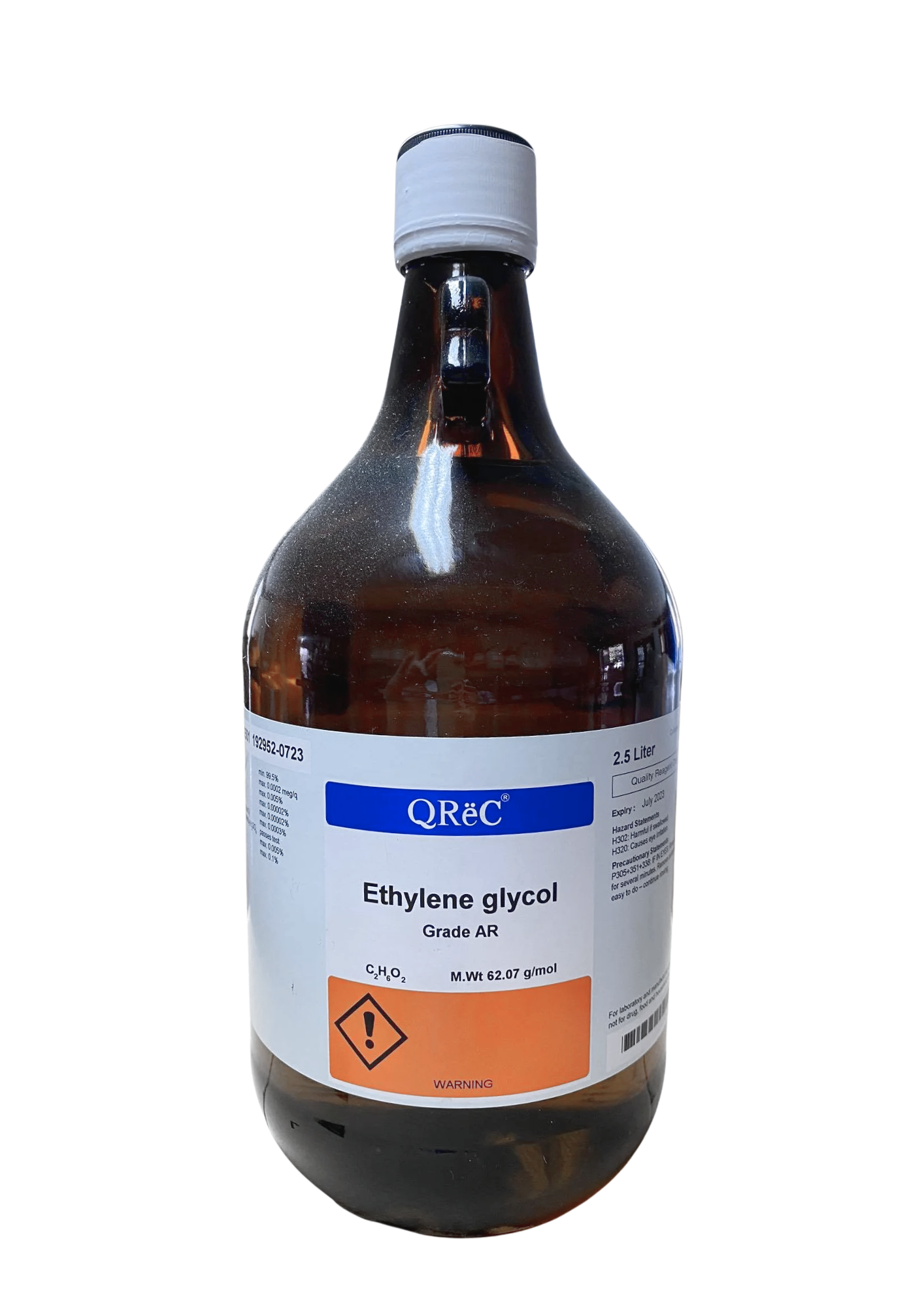
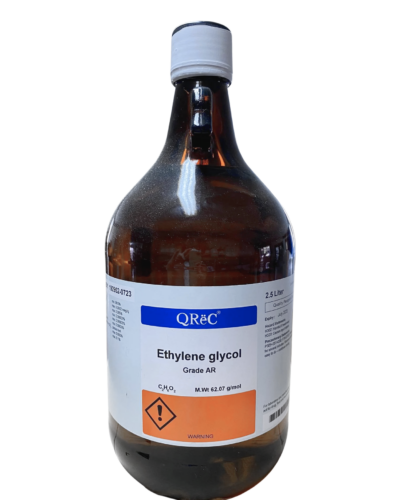
Ethylene glycol 99.5% or Ethane-1,2-diol or Monoethylene glycol (MEG) or 1,2-Dihydroxyethane
Product Overview & Quality
- Product Name: Ethylene glycol 99.5% or Ethane-1,2-diol or Monoethylene glycol (MEG) or 1,2-Dihydroxyethane
- Brand: QReC (Product Code: QR-E7152-1-2501)
- Grade: Analytical Reagent (AR Grade) featuring a high certified chemical purity of 99.5 percent or higher. Produced and fractionally distilled under strict QReC global laboratory specifications. Rigorously monitored to maintain exceptionally low ppm levels of moisture content (strictly below 0.1 percent), residue on ignition, chloride, sulfate, acidity, carbonyl compounds, and trace heavy metals (such as iron, lead, copper, and arsenic). Clear, high-purity diol profile free of visual coloration and ultraviolet-absorbing artifacts, guaranteeing optimal analytical baseline stability and consistent synthetic stoichiometry. Packaged in a heavy-duty amber glass bottle for maximum chemical integrity and light protection.
- Physical Properties: Clear, colorless, viscous, syrupy liquid with a practically odorless profile and a sweet taste (dangerously toxic). Strongly hygroscopic, readily absorbing moisture from ambient air. High boiling point (approximately 197 degrees Celsius) with extremely low ambient volatility. Combustible liquid with an elevated flash point (approximately 111 degrees Celsius); can ignite under substantial heating.
- Solubility: Completely miscible in all proportions with water, lower aliphatic alcohols (ethanol, methanol), acetone, glycerol, and glacial acetic acid; practically insoluble in diethyl ether, benzene, petroleum ether, chloroform, and hydrocarbons.
- Key Use: Heavily utilized as the primary heat-transfer fluid and antifreeze cryoprotectant in laboratory recirculating chillers, low-temperature baths, and instrument cooling loops, suppressing water freezing points down to below minus 40 degrees Celsius. Extensively applied as a high-boiling polar reaction solvent for high-temperature organic transformations. Serves as an essential protecting group reagent in organic synthesis, reacting with aldehydes and ketones under acid catalysis to form stable cyclic acetals or ketals (1,3-dioxolanes). Widely used as a difunctional monomer in polymer chemistry for synthesizing polyethylene terephthalate (PET) and polyester resins. Routinely utilized as a humectant, sample carrier, and dispersion medium in analytical spectroscopy, electrochemistry, and nanomaterial colloidal formulations.
Safety & Hazards (Critical, Ingestion Toxicity & Renal Damage)
- Classification: Harmful if swallowed. Causes damage to organs (Kidneys) through prolonged, repeated exposure, or single severe ingestion.
- Health Risks: Direct eye or skin contact causes mild, transient mechanical irritation or erythema. Inhalation of ambient vapors poses negligible hazard due to low volatility; however, inhaling mists or hot vapors generated from elevated heating produces mucosal respiratory irritation, coughing, headache, and dizziness. Ingestion is acutely life-threatening despite its sweet taste; in vivo hepatic metabolism rapidly oxidizes ethylene glycol to glycolic and oxalic acids, which chelate systemic calcium into insoluble calcium oxalate crystals that precipitate directly within renal tubules, causing severe metabolic acidosis, central nervous system depression, inebriation, convulsions, cardiopulmonary collapse, acute renal failure, and death.
- First Aid Measures: Immediately flush affected eyes or skin with an abundant stream of clean running water for at least 15 minutes while stripping contaminated garments. In case of vapor inhalation, relocate the individual to fresh air. If accidentally swallowed, do NOT induce vomiting; thoroughly rinse mouth with water, and seek immediate, urgent emergency medical attention without delay, alerting emergency physicians to acute ethylene glycol poisoning for targeted antidote intervention (such as Fomepizole or therapeutic ethanol administration).
Handling & Storage
- Storage: Hygroscopic Organic Diol and Specific Target Organ Toxicant. Readily absorbs atmospheric humidity. Must be preserved in its original, tightly closed QReC amber glass container. Store in a clean, cool, dry, and well-ventilated dedicated chemical store at controlled temperatures (below 25 to 30 degrees Celsius), sheltered from direct sunlight. Keep strictly segregated from strong oxidizing agents (such as nitric acid, potassium permanganate, and chromic acid, with which contact can trigger violent exothermic reactions), strong mineral acids, and strong bases.
- Precautions: Standard laboratory PPE is mandatory, including chemical-resistant nitrile gloves, splash-proof safety goggles, and a protective lab coat. Strictly prohibit eating, drinking, or food storage in areas where this substance is dispensed. Re-seal container tightly immediately after sampling to prevent atmospheric moisture uptake.