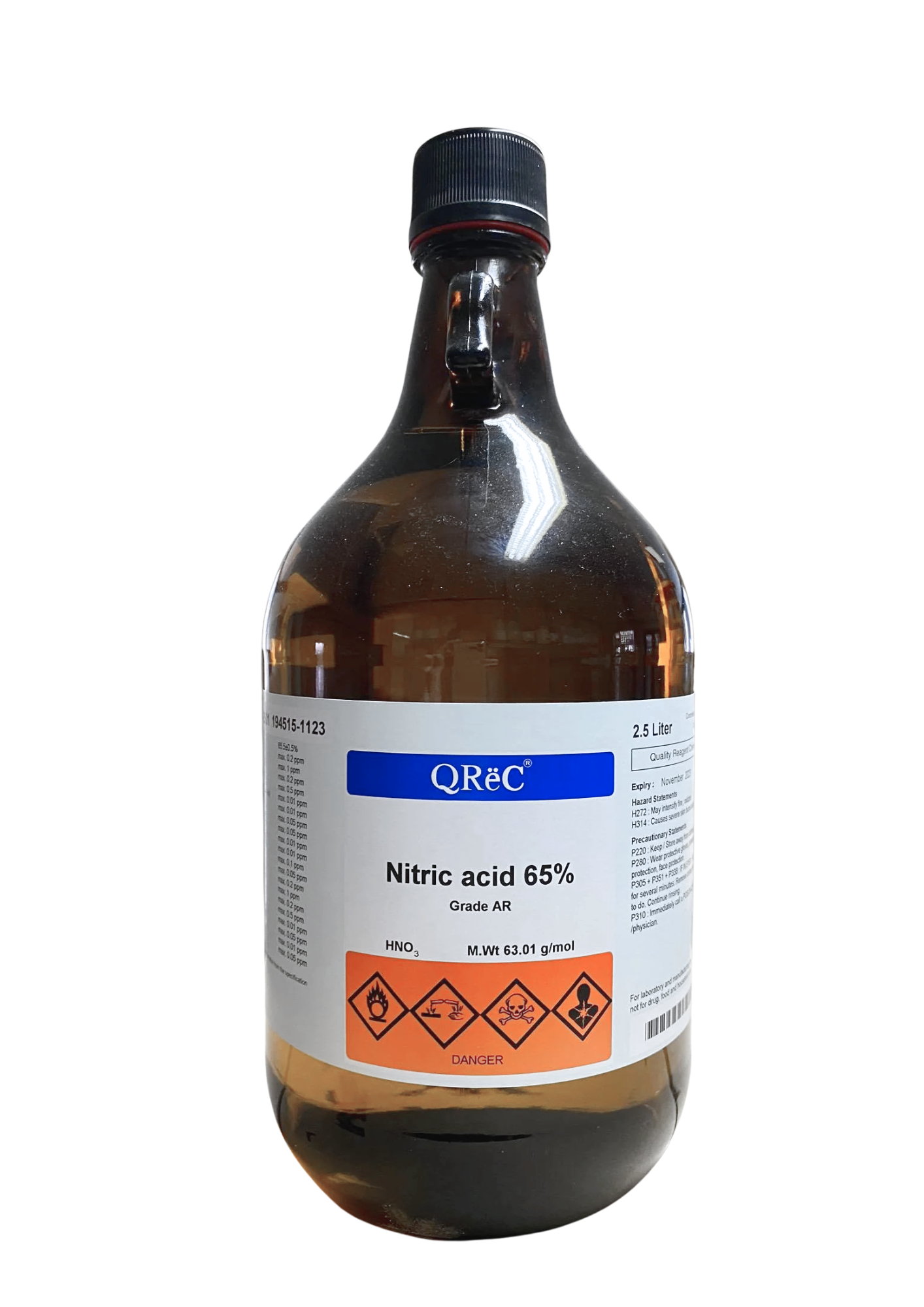
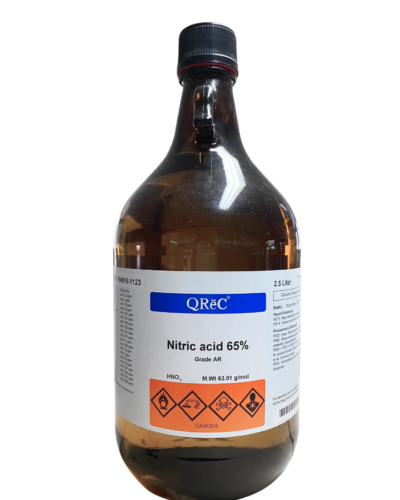
Nitric acid 65% or Aqua fortis or Hydrogen nitrate
Product Overview & Quality
- Product Name: Nitric acid 65% or Aqua fortis or Hydrogen nitrate
- Brand: QReC (Product Code: QR-N3115-1-2501)
- Grade: Analytical Reagent (AR Grade) featuring a certified nitric acid assay between 65.0 and 67.0 percent (nominal 65 percent concentration). Produced, purified, and stabilized under strict QReC global laboratory standards. Rigorously tested to enforce exceptionally low ppm and ppb limits of chloride, sulfate, phosphate, residue on ignition, and trace heavy metals (such as iron, lead, cadmium, copper, arsenic, mercury, nickel, and zinc). Delivers a water-white, low-background matrix ideal for high-precision trace element analysis. Packaged in a heavy-duty amber glass bottle for maximum chemical integrity and light protection.
- Physical Properties: Clear, colorless to faintly yellowish liquid (yellow tint develops naturally due to photochemical dissociation into nitrogen dioxide upon light or thermal exposure). Characteristic suffocating, acrid, sharp, biting odor. Emits acidic vapors into the air. Non-combustible alone, but functions as a powerful oxidizing agent that can spontaneously ignite combustible or organic materials upon contact. Intensely corrosive to biological tissues and metals.
- Solubility: Completely miscible in all proportions with water (dilution is an exothermic process releasing heat).
- Key Use: Heavily utilized as the premier mineral acid for wet acid digestion and sample decomposition in open vessels and closed-vessel microwave digestion systems, completely destroying organic matrices in foodstuffs, environmental soils, biological tissues, and polymers prior to trace metal quantification via AAS, ICP-OES, and ICP-MS. Essential constituent in formulating aqua regia (one part concentrated nitric acid to three parts concentrated hydrochloric acid) for dissolving noble metals such as gold and platinum. Standardly employed for acid washing laboratory glassware and PTFE vessels to eliminate trace metal contamination. Widely applied in organic nitration reactions for synthesizing chemical intermediates, and functions as a standard chemical etchant and passivation agent in metallography and materials science.
Safety & Hazards (Critical, Strong Oxidizer, Fatal Inhalation & Severe Corrosive)
- Classification: Oxidizing liquid (May intensify fire). Causes severe skin burns and eye damage. Causes serious eye damage. May be corrosive to metals. Fatal if inhaled. Harmful if swallowed.
- Health Risks: Direct eye contact produces instantaneous, catastrophic chemical burns, corneal opacification, conjunctival destruction, and permanent blindness. Dermal exposure induces deep, painful coagulative necrosis, severe blistering, and produces a characteristic, indelible yellow staining of the skin (xanthoproteic reaction) via nitration of epidermal aromatic amino acids. Inhalation of vapors or toxic nitrogen dioxide fumes (reddish-brown gases) aggressively attacks the respiratory tract, causing choking, coughing, severe dyspnea, laryngospasms, chemical pneumonitis, and delayed pulmonary edema which may prove fatal hours post-exposure. Ingestion causes devastating corrosive destruction of the mouth, esophagus, and gastrointestinal tract, accompanied by violent abdominal pain, perforation, hemorrhaging, shock, and death.
- First Aid Measures: Immediately flush affected eyes or skin with an abundant stream of clean flowing water for at least 15 to 20 minutes while stripping contaminated clothing. In case of vapor inhalation, rapidly relocate the victim to fresh air and keep at complete rest (clinical observation for delayed pulmonary edema is imperative). If accidentally swallowed, do NOT induce vomiting and do NOT attempt neutralization; thoroughly rinse mouth, administer water in moderate amounts if conscious, and seek immediate, urgent emergency medical attention.
Handling & Storage
- Storage: Strong Oxidizing Agent and Aggressive Corrosive Acid. Reacts violently or explosively upon contact with organic chemicals and combustible solvents. Must be preserved in its original, tightly closed QReC amber glass bottle placed in secondary acid-resistant containment trays. Store in a dedicated acid storage cabinet in a cool, dry, and well-ventilated chemical store at controlled temperatures (below 25 to 30 degrees Celsius), sheltered from direct sunlight and heat. Keep strictly segregated from organic solvents (such as ethanol, acetone, and ether), reducing agents, strong bases, flammable materials, finely powdered metals, and organic acids (such as acetic acid).
- Precautions: Full specialized PPE is mandatory, including heavy acid-resistant gloves (butyl or neoprene; standard thin nitrile gloves provide negligible protection against concentrated nitric acid), splash-proof safety goggles, a full-face safety shield, and an acid-resistant lab coat. Always open, handle, and dispense concentrated nitric acid exclusively within a certified, properly functioning laboratory fume hood. In dilution protocols, ALWAYS add concentrated nitric acid slowly into water with continuous stirring; NEVER add water to concentrated acid.