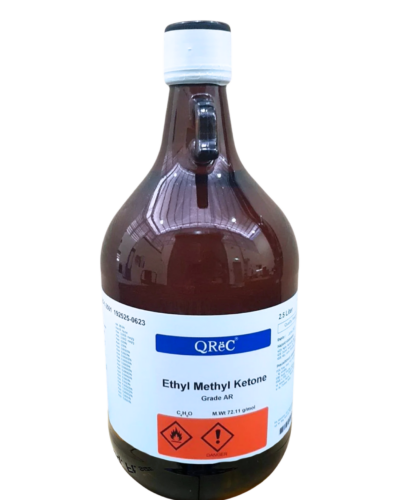
2-Butanone or Butan-2-one or Ethyl methyl ketone or MEK
Product Overview & Quality
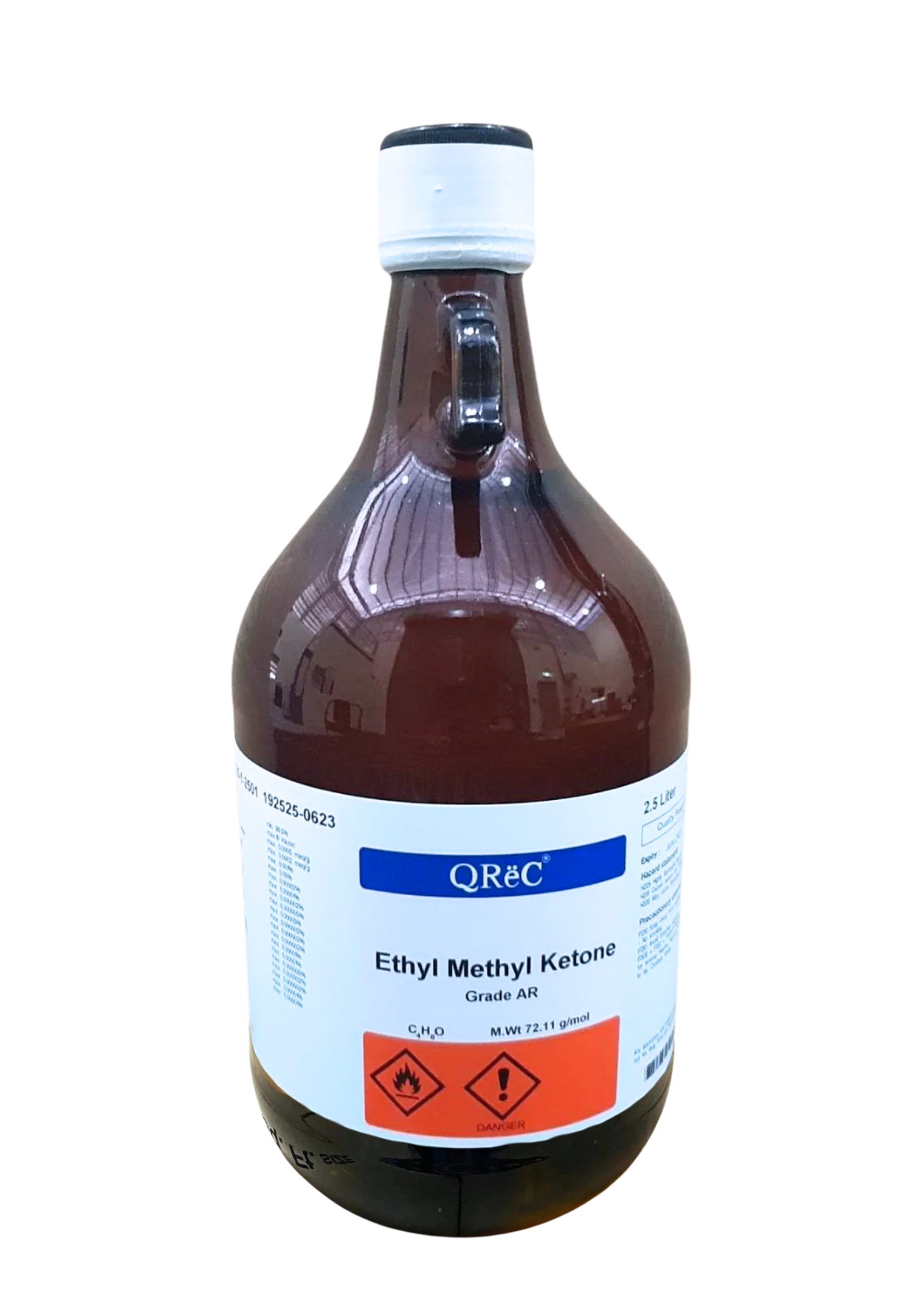
- Product Name: Methyl Ethyl Ketone 99.5% or 2-Butanone or Butan-2-one or Ethyl methyl ketone or MEK
- Brand: QReC (Product Code: QR-E7125-1-2501)
- Grade: Analytical Reagent High Purity Grade (AR Grade) featuring an exceptional certified chemical assay of not less than 99.5 percent in a 2,500 mL (2.5 L) Winchester amber glass container. Rectified and purified under strict QReC global laboratory specifications to ensure high baseline purity and reproducible solvency. Water and moisture content are tightly controlled below 0.1 percent. Acidity (calculated as acetic acid) is limited below 0.003 percent, with non-volatile evaporation residue held below 0.001 percent. Heavy-metal impurities (such as iron, lead, copper, zinc, and arsenic) are strictly maintained at minimal parts-per-million thresholds. Crystal-clear, colorless, particulate-free organic solvent packaged in a heavy-duty, solvent-resistant amber glass bottle fitted with an airtight double-seal vapor closure.
- Physical Properties: Clear, colorless, volatile, mobile liquid. Characteristic sharp, sweet, acetone-like minty odor. Boiling point is approximately 79.5 to 80.0 degrees Celsius. Closed-cup flash point is exceptionally low at approximately minus 9 to minus 4 degrees Celsius. Classified as a highly flammable liquid and vapour (Flammable Liquids Category 2). Vapors are heavier than air and may travel considerable distances along the ground to ignition sources and flash back. Neutral in aqueous solutions (pH approximately 5.5 to 7.0 at room temperature).
- Solubility: Moderately soluble in water (approximately 24 to 27 grams per 100 milliliters at 20 degrees Celsius; solubility exhibits inverse temperature dependence); completely miscible in all proportions with virtually all common organic solvents, including ethanol, methanol, diethyl ether, acetone, benzene, toluene, and chloroform.
- Key Use: Universally utilized as a premier analytical extraction and processing solvent for sample preparation, chemical fractionation, and organic synthesis. Extensively applied as a mobile phase modifier and extraction solvent in Thin-Layer Chromatography (TLC), High-Performance Liquid Chromatography (HPLC), and Gas Chromatography (GC) workflows. Heavily employed as an aggressive, high-solvency carrier for dissolving synthetic polymers, acrylic resins, cellulose nitrate, vinyl copolymers, surface coatings, lacquers, and industrial adhesives in materials science research. Functions as a precision degreasing and cleaning agent for removing oily contaminants and stubborn organic residues from laboratory glassware and mechanical assemblies without leaving residue. Serves as a versatile chemical intermediate and solvent for synthetic pharmaceutical and antioxidant reactions.
Safety & Hazards (Highly Flammable, Serious Eye Irritation & CNS Depression)
- Classification: Highly flammable liquid and vapour (Flammable Liquids Category 2). Causes serious eye irritation (Eye Irritation Category 2). May cause drowsiness or dizziness (Specific Target Organ Toxicity – Single Exposure Category 3). Repeated exposure may cause skin dryness or cracking (EUH066).
- Health Risks: Direct ocular contact triggers acute chemical stinging, conjunctival erythema, corneal irritation, edema, and profuse lacrimation. Prolonged or repeated dermal contact strips protective epidermal lipids, inducing skin dryness, cracking, peeling, and contact dermatitis. Inhalation of concentrated vapors irritates the mucous membranes of the respiratory tract, inducing coughing, sneezing, nasal irritation, headache, vertigo, nausea, fatigue, and central nervous system depression. Ingestion causes acute gastrointestinal irritation, burning of the oral cavity and throat, vomiting, and abdominal pain. Critical Risk: Ingestion carries a severe aspiration hazard, where accidental entry of liquid into the lungs during vomiting can provoke acute chemical pneumonitis and pulmonary edema.
- First Aid Measures: Immediately flush affected eyes with an abundant stream of clean flowing water for at least 15 minutes while stripping contaminated clothing; remove contact lenses promptly and seek immediate ophthalmological attention. Wash exposed skin thoroughly with soap and water. In case of vapor inhalation, relocate the individual to fresh air; maintain rest and warmth, and seek medical attention if symptoms persist. If accidentally swallowed, do NOT induce vomiting due to acute pulmonary aspiration hazard; thoroughly rinse mouth, administer water to drink, and seek emergency medical evaluation immediately.
Handling & Storage
- Storage: Highly Flammable Liquid with Low Flash Point and Vapor Explosion Hazard. Vapors readily accumulate to form explosive mixtures with air. Must be preserved in its original, tightly closed QReC amber glass container. Store in an approved, grounded flammable liquids storage cabinet within a clean, cool, dry, and well-ventilated dedicated chemical store at controlled temperatures (below 20 to 25 degrees Celsius), sheltered from open flames, electrical sparks, hot surfaces, direct sunlight, and static discharge. Keep strictly segregated from strong oxidizing agents (such as concentrated nitric acid, chromates, permanganates, and peroxides), strong mineral acids, caustic alkalis, and halogens.
- Precautions: Full protective PPE is mandatory, including chemical-resistant gloves (butyl rubber is strongly recommended; thin nitrile offers limited breakthrough protection against ketones), splash-proof safety goggles, an organic vapor respirator, and a protective lab coat. “Mandatory Safety Protocol: Dispense, transfer, and handle methyl ethyl ketone exclusively and strictly within a certified, spark-proof laboratory fume hood to prevent vapor accumulation and eliminate inhalation risks.” Keep dry chemical or carbon dioxide fire extinguishers accessible. Never discharge solvent residues directly into municipal sewer systems; collect exclusively in dedicated flammable organic solvent hazardous waste streams.