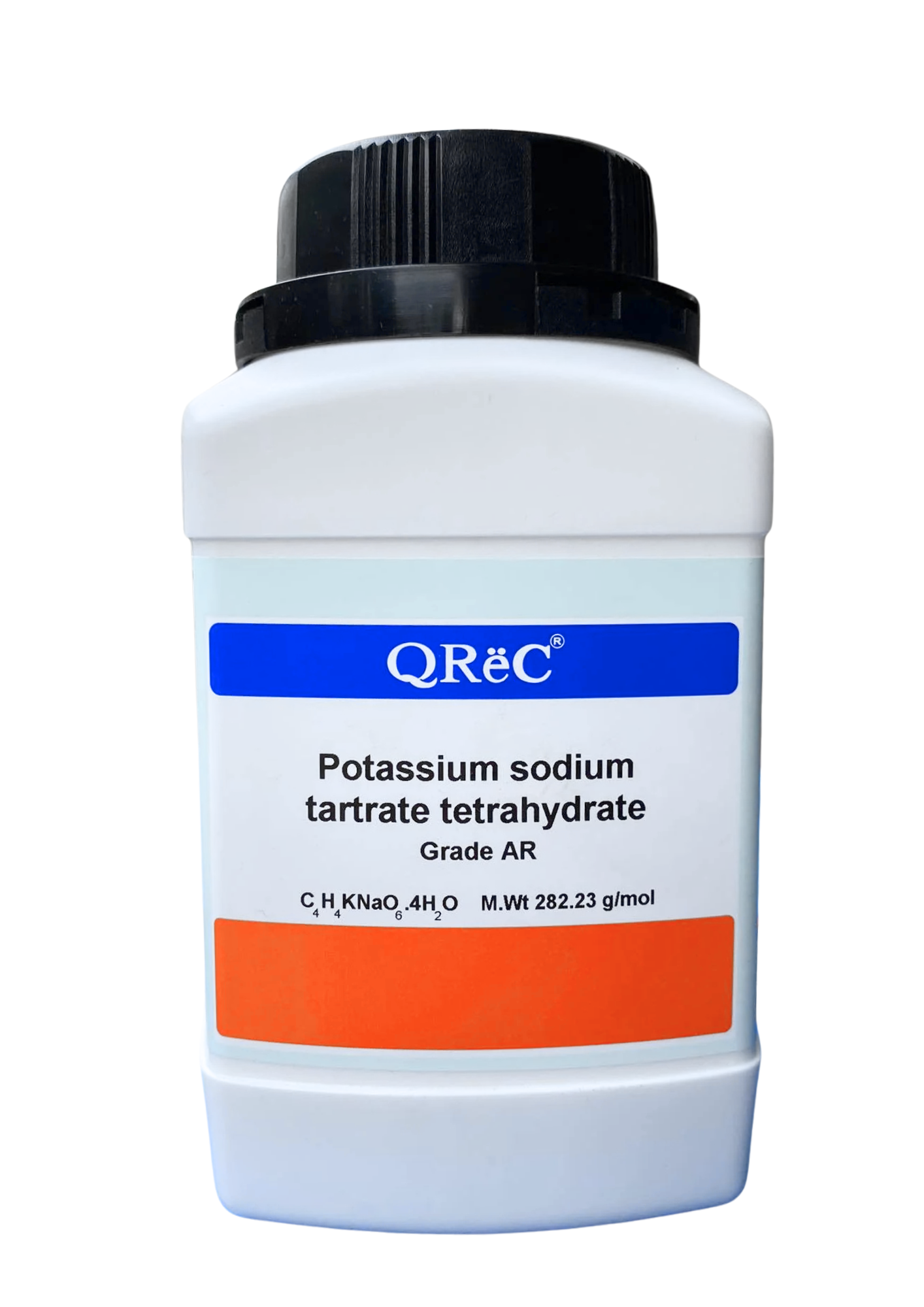
Potassium sodium tartrate tetrahydrate or Rochelle salt or Seignette’s salt or Potassium sodium 2,3-dihydroxybutanedioate
Product Overview & Quality
- Product Name: Potassium sodium tartrate 99% or Potassium sodium tartrate tetrahydrate or Rochelle salt or Seignette’s salt or Potassium sodium 2,3-dihydroxybutanedioate tetrahydrate
- Brand: QReC (Product Code: QR-P5234-1-0500)
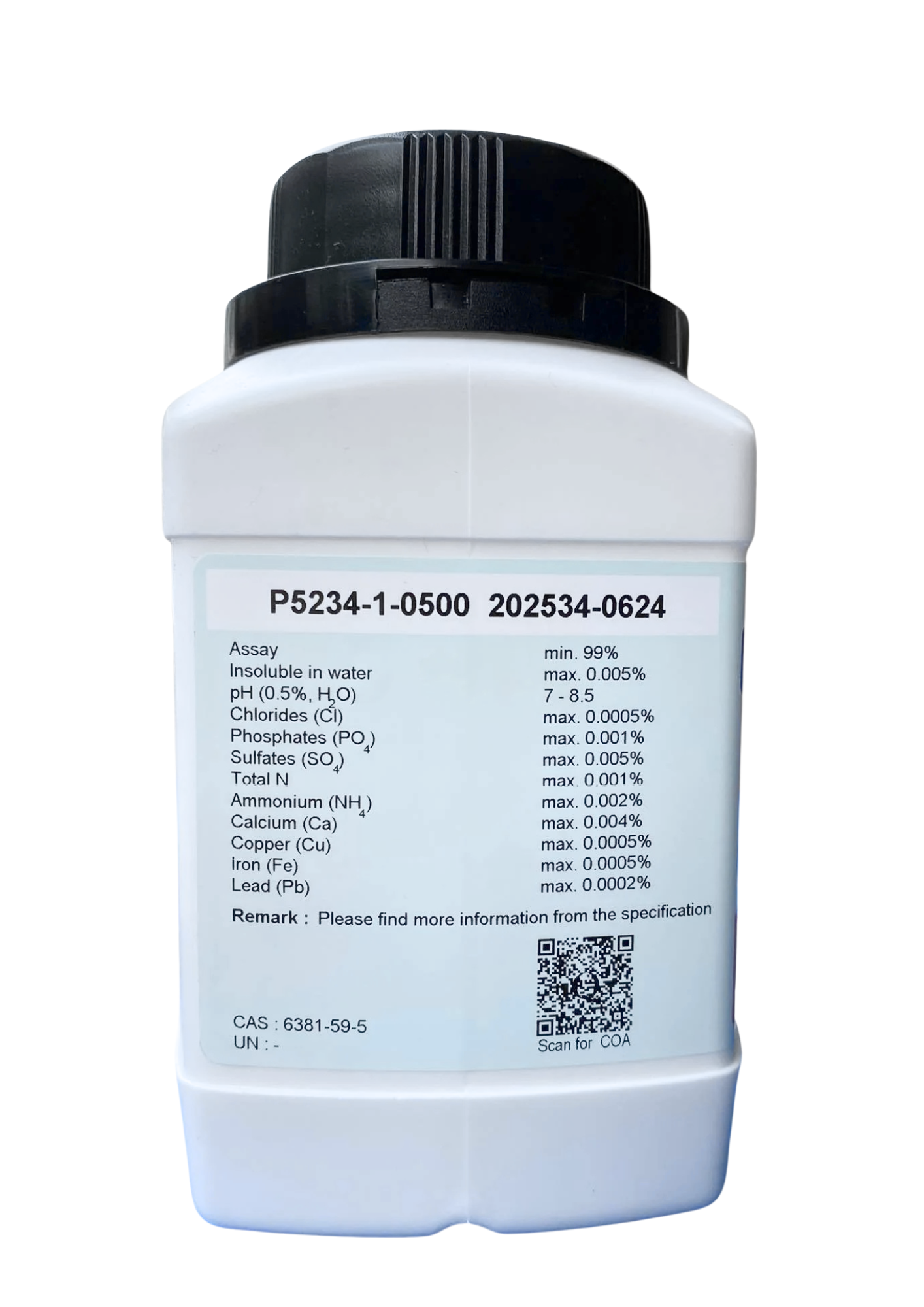
- Grade: Analytical Reagent High Purity Grade (AR Grade) featuring an exceptional certified chemical assay of not less than 99.0 percent in a 500 g laboratory package. Manufactured and multi-recrystallized under strict QReC global laboratory specifications without anti-caking conditioning additives, strictly maintaining stoichiometric tetrahydrate crystalline hydration. Rigorously analyzed to enforce minimal water-insoluble matter (strictly below 0.005 percent), alongside ultra-low ppm limits of chloride, sulfate, phosphate, ammonium, calcium, and trace heavy metals (such as iron, lead, copper, zinc, and arsenic). Dry, uniform translucent prisms dissolve cleanly and rapidly in water to yield crystal-clear, neutral-to-alkaline, particulate-free solutions. Packaged in a heavy-duty, moisture-barrier polymer container fitted with an airtight hermetic seal.
- Physical Properties: Colorless translucent orthorhombic crystals or fine white crystalline powder. Odorless with a cooling, saline taste. Slightly efflorescent in dry ambient air, gradually losing water of crystallization. Melting point is approximately 70 to 80 degrees Celsius. Non-combustible and non-corrosive solid. Aqueous solutions are practically neutral to weakly basic (pH approximately 6.5 to 8.5 for a 5 percent aqueous solution at room temperature). Notably displays historically prominent piezoelectric and ferroelectric properties in single crystals.
- Solubility: Readily and highly soluble in water (approximately 63 to 65 grams per 100 milliliters at 20 degrees Celsius, increasing to over 130 grams per 100 milliliters in boiling water); practically insoluble in ethanol and diethyl ether.
- Key Use: Universally utilized as the quintessential divalent metal chelating agent in preparing Fehling’s Solution B (formulated with sodium hydroxide) for the classic analytical detection and quantification of reducing sugars across food, beverage, and biological samples. Extensively applied as a stabilizing complexing agent in the Biuret Reagent to chelate and maintain cupric ions in alkaline solution for colorimetric total protein determinations in biochemistry and clinical diagnostic testing. Heavily employed as a complexing and buffering additive in metal electroplating, electroless copper bath formulations, and chemical silvering of mirrors to regulate free metal cation kinetics. Widely utilized in solid-state physics and materials science as a prototypical ferroelectric and piezoelectric substrate. Serves as a versatile buffer component, protein crystallization precipitant, and analytical reagent in wet chemical analysis.
Safety & Hazards
- Classification: Non-hazardous substance under standard GHS criteria in routine laboratory handling. Exceptionally low acute toxicity profile; particulate dust may exert mild mechanical irritation to ocular, dermal, and upper respiratory surfaces.
- Health Risks: Direct eye contact may cause transient mechanical stinging, conjunctival redness, or lacrimation. Prolonged dermal contact may produce mild dryness or superficial contact irritation. Inhalation of particulate dust can cause minor sneezing, coughing, or upper respiratory discomfort. Ingestion of excessive quantities may provoke transient gastrointestinal upset, abdominal cramps, nausea, or mild osmotic saline laxative effects characteristic of tartrate salts.
- First Aid Measures: Flush affected eyes thoroughly with clean running water for at least 10 to 15 minutes. Wash exposed skin with soap and water. In case of dust inhalation, relocate the individual to fresh air. If accidentally swallowed in substantial amounts, rinse mouth thoroughly, drink water, and seek medical advice if discomfort persists.
Handling & Storage
- Storage: Stable Analytical Organic Salt. Must be preserved in its original, tightly closed QReC container. Store in a clean, strictly dry, cool, and well-ventilated dedicated chemical store at controlled temperatures (below 25 to 30 degrees Celsius), sheltered from atmospheric moisture and direct sunlight. Keep strictly segregated from strong oxidizing agents, strong mineral acids, and heavy metal cations that form insoluble tartrates (such as calcium, barium, and lead).
- Precautions: Standard laboratory PPE is mandatory, including protective gloves, safety glasses, and a protective lab coat. Re-seal container cap tightly immediately after sampling to prevent efflorescent dehydration or moisture uptake. Minimize dust generation during weighing and dispensing.