
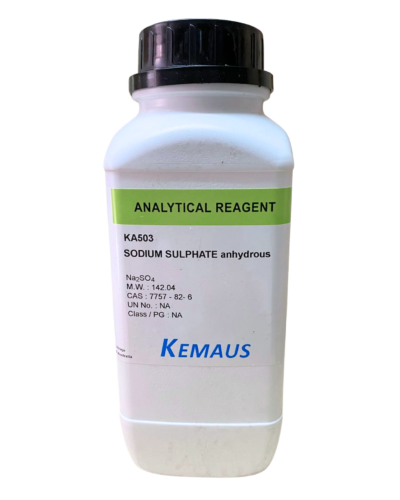

Sodium sulfate anhydrous
Product Overview & Quality
- Product Name: Sodium sulfate anhydrous
- Brand: Kemaus (Product Code: KA-503)
- Grade: Analytical Reagent (AR Grade) with premium purity of 99 percent or higher. Manufactured under strict Kemaus laboratory standards, ensuring an entirely moisture-free matrix with ultra-low trace background contaminants to maximize its chemical drying performance.
- Physical Properties: Odorless, fine white powder or crystalline granules with a bitter-salty taste.
- Solubility: Highly soluble in water; insoluble in most organic solvents.
- Key Use: Widely utilized as a primary drying agent (desiccant) in organic chemistry laboratories to remove residual traces of water from organic extracts and solvent phases post-extraction. Also used as a high-purity reagent for formulating laboratory buffer solutions and preparing environmental analytical samples.
Safety & Hazards
- Classification: Not classified as a hazardous substance according to GHS regulations. Acts as a mild physical and mechanical dust irritant.
- Health Risks: Direct eye contact with fine dust may cause temporary mechanical irritation, watering, or redness. Inhalation of large amounts of dust may cause minor coughing, sneezing, or nasal tract discomfort.
- First Aid Measures: Flush eyes immediately with plenty of water for at least 15 minutes. Wash affected skin with soap and water. Seek medical advice if irritation develops or persists.
Handling & Storage
- Storage: Highly Hygroscopic. It aggressively absorbs atmospheric moisture, which can cause caking and loss of drying efficacy. Must be stored in the original, tightly sealed Kemaus container in a cool, strictly dry, and well-ventilated space at stable room temperature (below 30 degrees Celsius).
- Precautions: Wear standard personal protective equipment (PPE), including laboratory gloves, safety glasses, and a particulate dust mask. Ensure the container is capped tightly immediately after each use to protect its anhydrous properties.