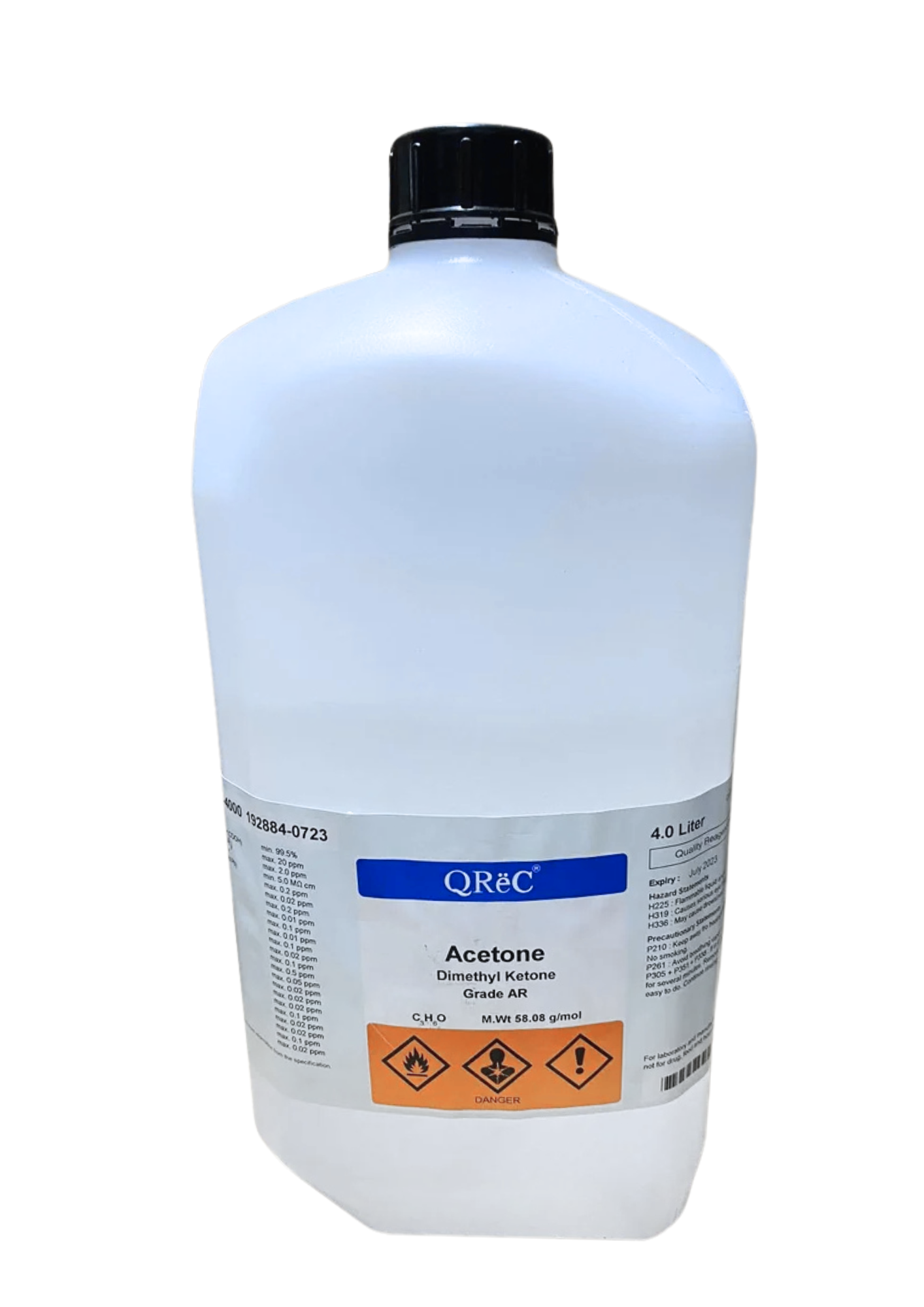
Acetone or Propanone or Dimethyl ketone or 2-Propanone
Product Overview & Quality
- Product Name: Acetone or Propanone or Dimethyl ketone or 2-Propanone
- Brand: QReC (Product Code: QR-A1084-1-4000)
- Grade: Analytical Reagent (AR Grade) featuring a certified chemical assay of not less than 99.5 percent in an economical 4,000 mL (4 L) laboratory volume. Refined and purified via high-efficiency distillation under strict QReC global laboratory specifications. Rigorously tested to enforce an exceptionally low non-volatile residue after evaporation (strictly below 0.001 percent), leaving zero oily film or watermark residue upon drying. Water content is tightly controlled below 0.2 percent. Enforces minimal ppm thresholds of acidity, alkalinity, methanol, ethanol, aldehydes, and trace heavy metals. Crystal-clear, particulate-free organic solvent packaged in a heavy-duty, solvent-resistant 4-liter polymer container fitted with a tamper-evident hermetic closure.
- Physical Properties: Clear, colorless, volatile liquid with a characteristic sweet, pungent, fruity odor. Highly volatile at ambient conditions with a boiling point of approximately 56 degrees Celsius. Extremely low closed-cup flash point at approximately minus 20 degrees Celsius. Classified as a highly flammable liquid and vapour (Category 2). Vapors are heavier than air and capable of traveling considerable distances along floors to distant ignition sources, flashing back.
- Solubility: Completely miscible in all proportions with water; fully miscible with virtually all organic solvents, including ethanol, methanol, diethyl ether, chloroform, benzene, toluene, and aliphatic hydrocarbons. Demonstrates powerful solvency toward lipids, gums, resins, cellulose derivatives, and synthetic polymers.
- Key Use: Universally utilized as the standard solvent for cleaning, degreasing, and rapid drying of laboratory glassware and analytical apparatus, stripping organic residues and extracting residual water without leaving residue. Extensively applied paired with dry ice (solid carbon dioxide) to formulate classic cold baths (Dry Ice / Acetone Bath) maintaining stable cryogenic temperatures of approximately minus 78 degrees Celsius for reaction cooling and trap condensations. Serves as a versatile dipolar aprotic reaction solvent and reagent in synthetic organic chemistry, nucleophilic substitutions, and for compounding Jones Reagent oxidations. Heavily used as an extraction solvent for isolating phytochemicals, plant pigments, natural fats, and essential oils. Widely employed in industrial quality control, precision parts degreasing, and general spectroscopic sample preparation.
Safety & Hazards (Highly Flammable, Eye Irritation & Central Nervous System Depression)
- Classification: Highly flammable liquid and vapour (Flammable Liquids Category 2). Causes serious eye irritation (Eye Irritation Category 2). May cause drowsiness or dizziness (Specific Target Organ Toxicity – Single Exposure Category 3: Central Nervous System). Repeated exposure may cause skin dryness or cracking.
- Health Risks: Direct ocular contact triggers acute burning pain, intense stinging, conjunctival redness, corneal irritation, and profuse lacrimation. Prolonged or repeated dermal exposure strips natural cutaneous lipids, causing localized skin dryness, scaling, fissures, and erythema. Inhalation of concentrated vapors aggressively irritates the upper respiratory tract, causing coughing, nasal irritation, and induces central nervous system depression characterized by headache, lightheadedness, dizziness, fatigue, nausea, incoordination, and potential narcosis or loss of consciousness in unventilated areas. Ingestion causes gastrointestinal irritation, epigastric burning pain, nausea, vomiting, and alcohol-like systemic intoxication.
- First Aid Measures: Immediately flush affected eyes with an abundant stream of clean flowing water for at least 15 minutes while stripping contaminated clothing; remove contact lenses promptly and seek medical attention if irritation persists. Wash exposed skin thoroughly with soap and water. In case of vapor inhalation, rapidly relocate the victim to fresh air; maintain rest and warmth. If accidentally swallowed, do NOT induce vomiting; thoroughly rinse mouth, administer water in moderate amounts, and seek prompt medical attention.
Handling & Storage
- Storage: Highly Flammable, Volatile Organic Solvent. Static electricity, open flames, or hot surfaces trigger rapid vapor ignition. Must be preserved in its original, tightly closed QReC 4-liter container. Store in an approved, grounded flammable liquids storage cabinet within a clean, cool, dry, and well-ventilated dedicated chemical store at controlled temperatures (preferably below 20 to 25 degrees Celsius), completely sheltered from direct sunlight, open flames, sparks, and electrostatic discharge. Keep strictly segregated from strong oxidizing agents (such as chromium trioxide, concentrated nitric acid, hydrogen peroxide, and perchlorates), strong mineral acids, and strong bases (violent exothermic decomposition or deflagration can occur upon contact with strong oxidizers).
- Precautions: Standard specialized PPE is mandatory, including solvent-resistant protective gloves (butyl rubber gloves are recommended; thin disposable nitrile offers only splash protection), splash-proof safety goggles, and an anti-static lab coat. “Mandatory Protocol: Dispense, transfer, and handle acetone exclusively within a certified, spark-proof laboratory fume hood.” Ground and bond dispensing equipment during large-volume transfers. Keep dry chemical or carbon dioxide fire extinguishers accessible. Never discharge acetone rinsates directly into municipal sewers; collect in dedicated halogen-free flammable solvent waste streams.