

Benzenecarboxylic acid or Carboxybenzene or Phenylcarboxylic acid or Dracylic acid
Product Overview & Quality
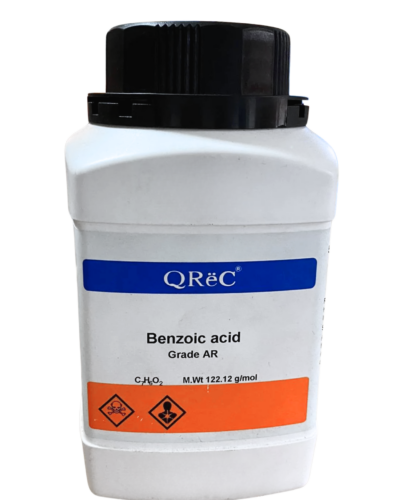
- Product Name: Benzoic acid 99.9% or Benzenecarboxylic acid or Carboxybenzene or Phenylcarboxylic acid or Dracylic acid
- Brand: QReC (Product Code: QR-B2042-1-0500)
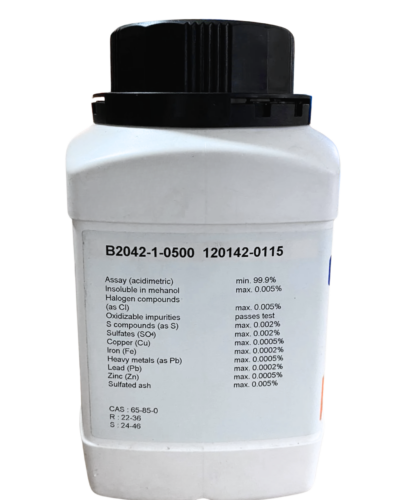
- Grade: Analytical Reagent High Purity / Primary Standard Grade (AR Grade) featuring an exceptional certified chemical assay of not less than 99.9 percent in a 500 g laboratory container. Synthesized, multi-crystallized, and purified under strict QReC global laboratory specifications without flow additives. Displays a sharply defined, narrow melting point range (122.0 to 123.0 degrees Celsius). Strictly analyzed to enforce an ultra-low residue on ignition (strictly below 0.005 percent), alongside minimal ppm thresholds of total chlorine compounds, sulfur compounds, and trace heavy metals (such as iron, lead, copper, arsenic, and zinc). Methanol-insoluble matter is strictly restricted below 0.005 percent. Uniform, dry crystalline needles dissolve cleanly in organic solvents and boiling water, yielding crystal-clear solutions free of particulate impurities. Packaged in a heavy-duty, chemical-resistant polymer container equipped with a secure double hermetic seal to prevent sublimation losses.
- Physical Properties: White lustrous crystalline needles, scales, or fine white crystalline powder. Odorless to faint characteristic pleasant aromatic odor (resembling benzoin gum). Thermodynamically stable in ambient air; sublimes slowly at ambient conditions and rapidly above 100 degrees Celsius. Combustible solid under high thermal stress with a flash point of approximately 121 degrees Celsius. Aqueous solutions are weakly acidic (pH approximately 2.8 to 3.0 for a saturated aqueous solution at room temperature).
- Solubility: Sparingly soluble in water at room temperature (approximately 0.29 to 0.34 grams per 100 milliliters at 20 degrees Celsius; solubility increases dramatically in boiling water, exceeding 5.5 to 6.0 grams per 100 milliliters at 100 degrees Celsius); freely soluble in ethanol, methanol, diethyl ether, acetone, chloroform, and benzene; dissolves readily in aqueous caustic alkali solutions to form soluble benzoate salts.
- Key Use: Universally utilized as the international Primary Thermochemical Standard for calibrating the effective heat capacity (water equivalent factor) of oxygen bomb calorimeters used in determining the gross calorific value of coal, petroleum fuels, biofuels, combustible wastes, and foodstuffs. Extensively applied as a Primary Standard for standardizing strong non-aqueous basic titrants (such as sodium methoxide or tetrabutylammonium hydroxide solutions) in non-aqueous acid-base volumetric titrations. Serves as a vital organic chemical intermediate and starting precursor for synthesizing benzoyl chloride, benzoate esters, specialized plasticizers, and dye compounds in preparative organic chemistry. Heavily employed as an analytical reference standard in High-Performance Liquid Chromatography (HPLC) and Gas Chromatography (GC) for qualifying and quantifying food preservative residues across food, beverage, cosmetic, and pharmaceutical matrices. Widely used as an antifungal and antimicrobial preservative in biological specimen preservation and histological formulations.
Safety & Hazards (Specific Lung Damage via Inhalation, Serious Eye Damage & Skin Irritant)
- Classification: Causes damage to organs (Lungs, respiratory tract) through prolonged or repeated exposure by inhalation (Specific Target Organ Toxicity – Repeated Exposure Category 1). Causes serious eye damage (Eye Damage Category 1). Causes skin irritation (Skin Irritation Category 2). Harmful if swallowed (Acute Toxicity Oral Category 4).
- Health Risks: Direct ocular contact triggers severe caustic stinging, intense conjunctival erythema, corneal ulceration, and potential irreversible visual impairment. Dermal contact causes localized erythema, stinging, pruritus, peeling, and can induce contact urticaria. Inhalation of particulate dust or sublimed vapors aggressively irritates the upper respiratory tract, causing coughing, sneezing, choking, and dyspnea. Critical Cumulative Toxicity: Chronic occupational inhalation of airborne benzoic acid dust causes progressive pulmonary fibrosis and irreversible respiratory organ impairment. Ingestion induces acute gastrointestinal irritation, burning oral and epigastric pain, nausea, vomiting, abdominal cramping, and metabolic disturbances.
- First Aid Measures: Immediately flush affected eyes with an abundant stream of clean flowing water for at least 15 to 20 minutes while stripping contaminated clothing; remove contact lenses promptly and seek immediate emergency ophthalmological care. Wash exposed skin thoroughly with soap and water for at least 15 minutes. In case of dust or vapor inhalation, rapidly relocate the victim to fresh air; maintain complete rest and seek prompt medical attention. If accidentally swallowed, do NOT induce vomiting; thoroughly rinse mouth, administer water in moderate amounts, and seek immediate medical attention.
Handling & Storage
- Storage: Sublimable Organic Acid and Specific Lung Toxin. Thermal exposure induces rapid vapor sublimation that recrystallizes onto container walls. Must be preserved in its original, tightly closed QReC container. Store in a clean, strictly dry, cool, and well-ventilated dedicated chemical store at controlled temperatures (below 25 to 30 degrees Celsius), sheltered from atmospheric humidity and direct sunlight. Keep strictly segregated from strong oxidizing agents (such as permanganates, perchlorates, and peroxides), strong caustic alkalis, and strong reducing agents.
- Precautions: Full specialized PPE is mandatory, including protective nitrile gloves, splash-proof safety goggles, a certified particulate/organic vapor dust respirator, and a protective lab coat. Perform weighing, thermal heating, and dispensing strictly inside a certified laboratory fume hood to prevent inhalation of sublimed acid vapors. Re-seal container cap tightly immediately after sampling to prevent sublimation loss. Minimize dust generation during weighing and dispensing.