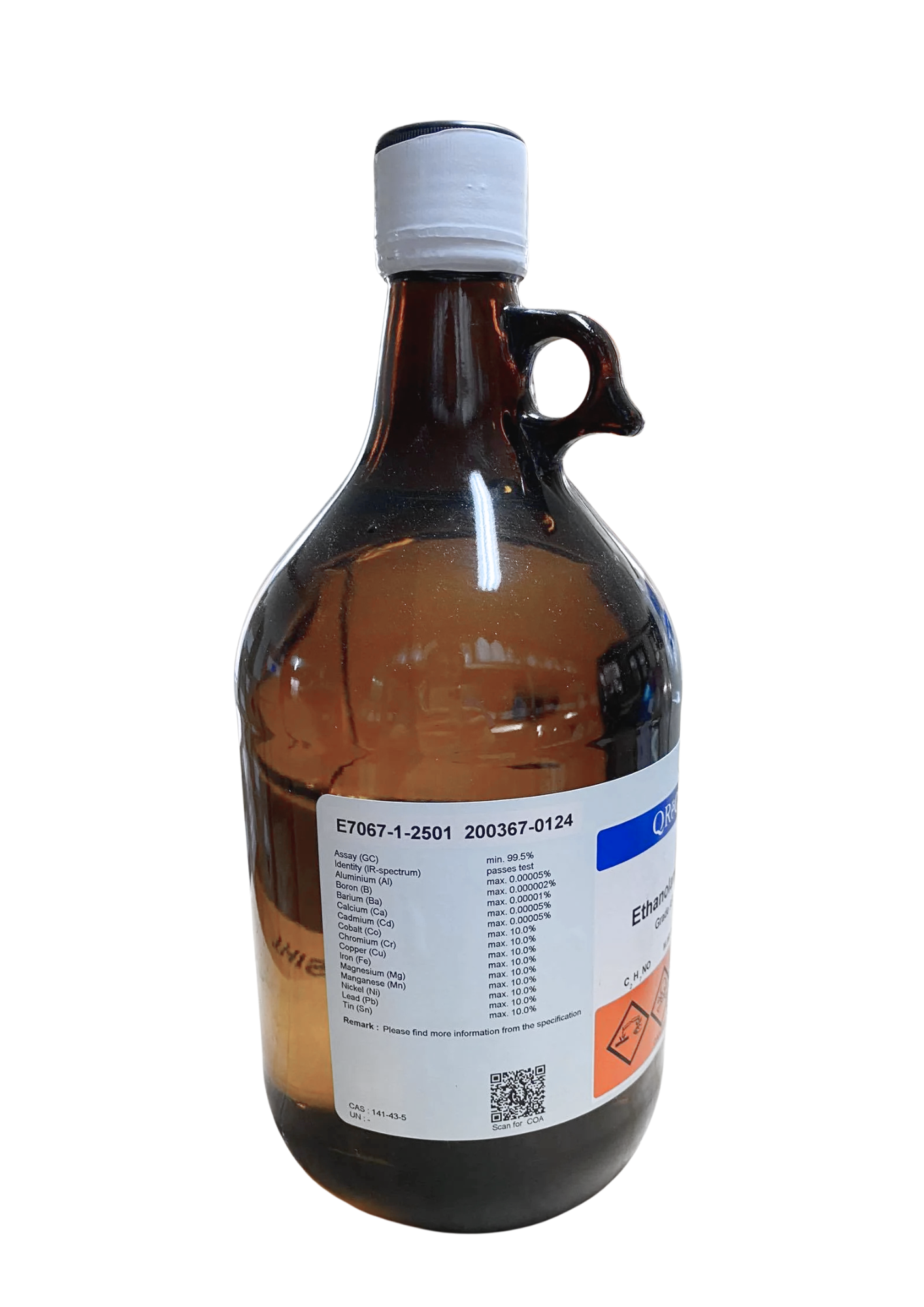
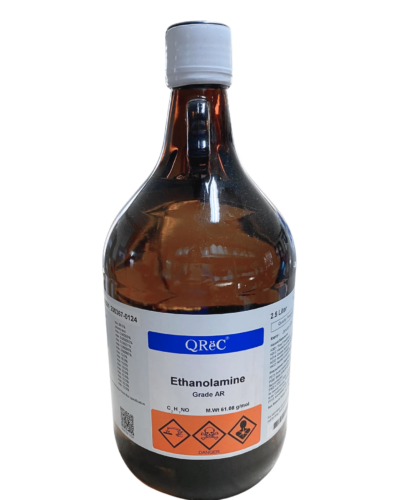
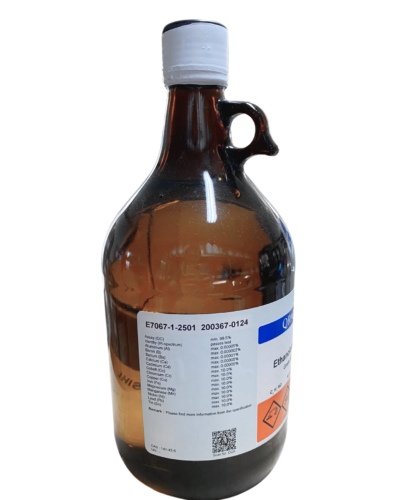
Monoethanolamine or 2-Aminoethanol or 2-Hydroxyethylamine
Product Overview & Quality
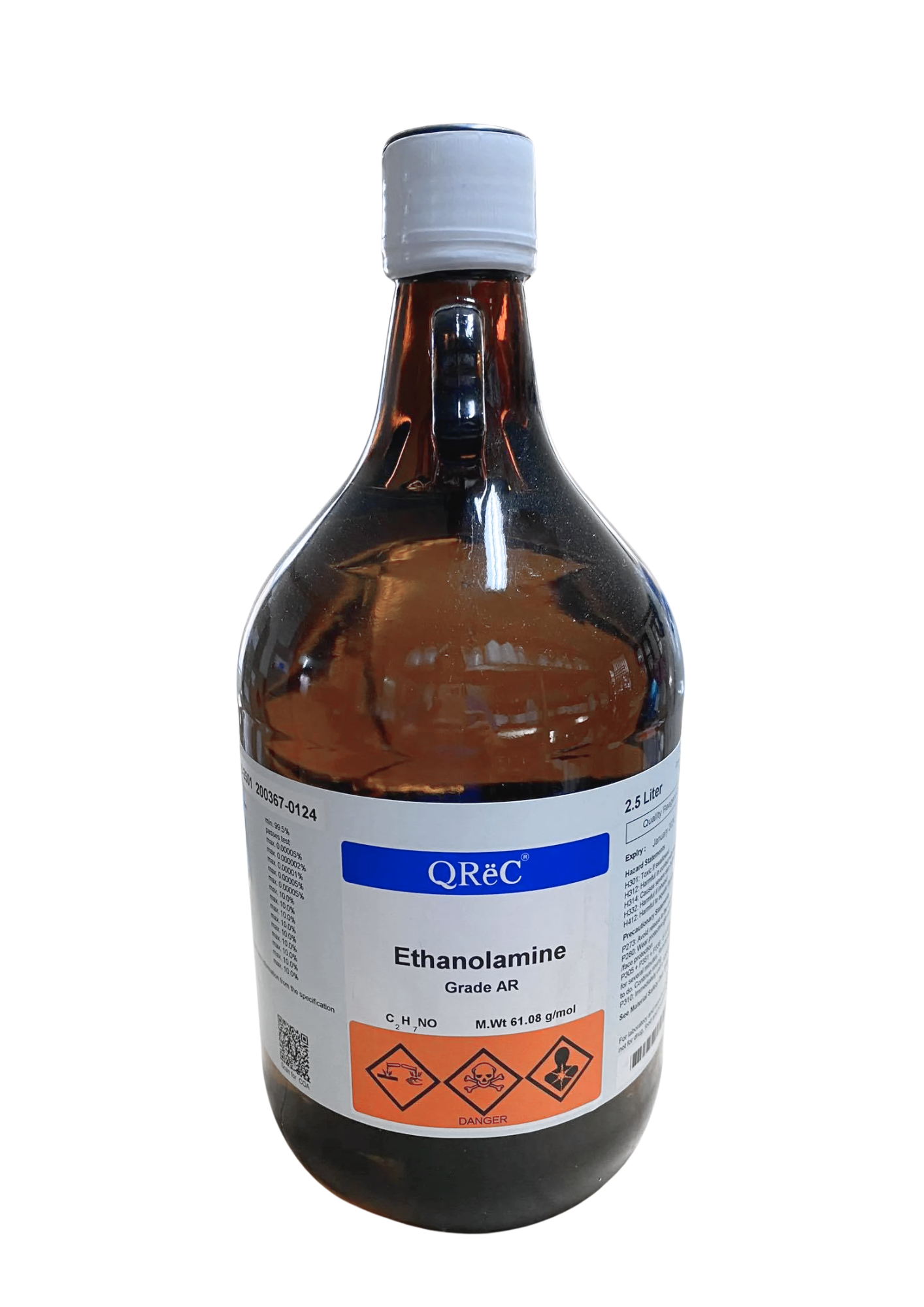
- Product Name: Ethanolamine 99.5% or Monoethanolamine (MEA) or 2-Aminoethanol or 2-Hydroxyethylamine
- Brand: QReC (Product Code: QR-E7067-1-2501)
- Grade: Analytical Reagent High Purity Grade (AR Grade) featuring an exceptional certified chemical assay of not less than 99.5 percent in a 2,500 mL (2.5 L) amber glass Winchester bottle. Rectified and purified under strict QReC global laboratory specifications. Water content is tightly restricted below 0.2 percent, and non-volatile residue after evaporation is controlled below 0.005 percent. Diethanolamine and triethanolamine homologous impurities are restricted to trace levels. Trace heavy metals (such as iron, lead, copper, zinc, and nickel) are monitored at minimal ppm thresholds. Clear, colorless, high-purity organic amine liquid packaged in a heavy-duty, amber glass container equipped with a hermetic double-seal closure to isolate the liquid from ambient moisture and carbon dioxide.
- Physical Properties: Clear, colorless, moderately viscous liquid with a characteristic unpleasant, ammoniacal odor. Highly hygroscopic and readily absorbs carbon dioxide from ambient air to form carbamate salts. Boiling point is approximately 170 degrees Celsius; freezing point is approximately 10 to 11 degrees Celsius (solidifies into a waxy crystalline mass in refrigerated environments). Flash point is approximately 93 degrees Celsius. Aqueous matrices are strongly basic (pH approximately 12.0 for a 10 percent aqueous solution at room temperature) and corrosive to biological tissues, copper, brass, and aluminum alloys.
- Solubility: Completely miscible in all proportions with water (dissolution is exothermic); fully miscible with methanol, ethanol, acetone, and glycerol; moderately soluble in diethyl ether and chloroform; practically insoluble in benzene and aliphatic hydrocarbons.
- Key Use: Universally utilized as the standard chemical absorption solvent in engineering and environmental research for Carbon Capture and Storage (CCS) and acid gas scrubbing (removal of carbon dioxide and hydrogen sulfide from natural gas and synthesis gas streams). Extensively applied as an organic alkaline buffering modifier in High-Performance Liquid Chromatography (HPLC), capillary electrophoresis, and biochemical formulations. Serves as a blocking and quenching reagent in bioconjugation protocols, antibody immobilization, and enzyme-linked immunosorbent assays (ELISA) to deactivate residual active ester groups. Widely employed as a chemical precursor for synthesizing specialty surfactants, emulsifiers, corrosion inhibitors, and pharmaceutical intermediates. Functions as a chelating and extraction agent for multivalent transition metals in analytical metallurgy and coordination chemistry.
Safety & Hazards (Corrosive Skin Burns, Serious Eye Damage & Acute Toxicity)
- Classification: Harmful if swallowed (Acute Toxicity Oral Category 4). Harmful in contact with skin (Acute Toxicity Dermal Category 4). Harmful if inhaled (Acute Toxicity Inhalation Category 4). Causes severe skin burns and eye damage (Skin Corrosion Category 1B). Causes serious eye damage (Eye Damage Category 1). May cause respiratory irritation (Specific Target Organ Toxicity – Single Exposure Category 3). Harmful to aquatic life.
- Health Risks: Aqueous matrices are strongly alkaline and caustic. Direct ocular contact causes rapid corneal ulceration, severe stinging pain, conjunctival edema, and risk of permanent blindness. Dermal exposure produces chemical burns, deep tissue ulceration, blistering, and dermatitis. Inhalation of concentrated vapors or mists aggressively irritates the mucous membranes of the respiratory tract, inducing coughing, sneezing, choking, bronchospasm, and dyspnea. Ingestion causes severe corrosive destruction of the oral cavity, pharynx, esophagus, and stomach, accompanied by intense epigastric pain, nausea, vomiting, diarrhea, and potential esophageal stricture.
- First Aid Measures: Immediately flush affected eyes with an abundant stream of clean flowing water for at least 15 to 20 minutes while holding eyelids open; remove contact lenses promptly and seek immediate emergency ophthalmological attention. Wash exposed skin thoroughly with abundant water for at least 15 minutes while stripping contaminated clothing. In case of vapor inhalation, rapidly relocate the victim to fresh air. If accidentally swallowed, do NOT induce vomiting; thoroughly rinse mouth, administer water in moderate amounts, and seek immediate emergency medical care.
Handling & Storage
- Storage: Corrosive, Strongly Alkaline, Highly Hygroscopic, and Carbon Dioxide-Sensitive Liquid. Atmospheric exposure triggers rapid water uptake and carbonation. Must be preserved in its original, tightly closed QReC amber glass container placed in secondary containment. Store in an approved alkali storage cabinet within a clean, cool, dry, and well-ventilated dedicated chemical store at controlled temperatures (below 25 degrees Celsius), sheltered from atmospheric moisture and direct sunlight. Keep strictly segregated from strong mineral acids (contact triggers violent exothermic neutralization reactions), strong oxidizing agents, chlorinated hydrocarbons, aluminum, copper, and zinc.
- Precautions: Comprehensive specialized PPE is mandatory, including chemical-resistant nitrile or butyl rubber gloves, splash-proof safety goggles paired with a full-face shield, an alkaline-resistant apron, and a protective lab coat. Dispense, measure, and handle concentrated ethanolamine strictly inside a certified laboratory fume hood. Re-seal container cap tightly immediately after sampling. Neutralize alkaline waste residues carefully before disposal; never discharge concentrated amino alcohols directly into municipal sewers.