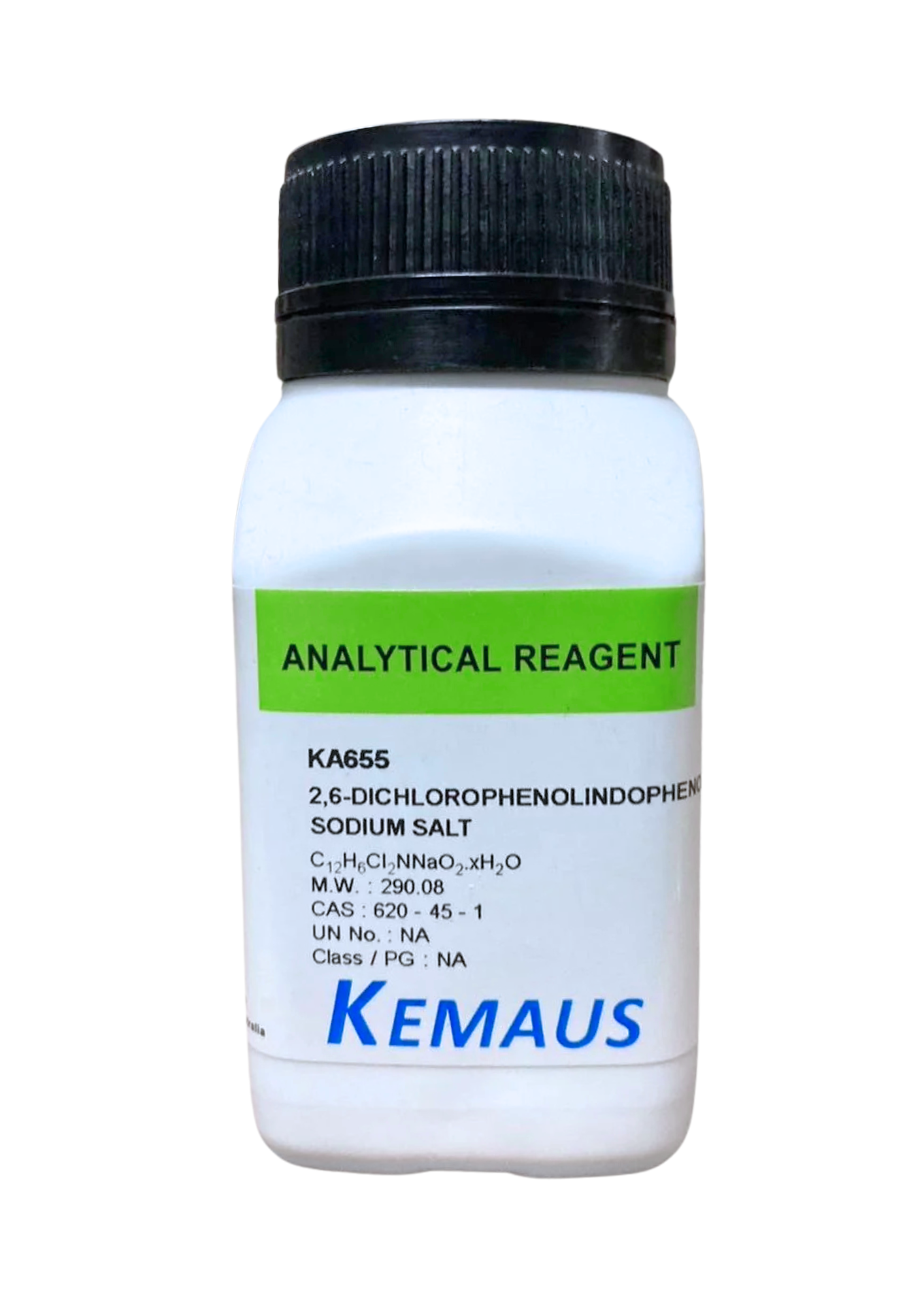
2,6-Dichlorophenol indophenol sodium salt (DCPIP)
Product Overview & Quality
- Product Name: 2,6-Dichlorophenol indophenol sodium salt (DCPIP)
- Brand: Kemaus (Product Code: KA-655)
- Grade: Analytical Reagent (AR Grade) with a premium purity of 98 percent or higher. Meticulously manufactured and verified under Kemaus strict laboratory quality control standards to ensure ultra-low background contamination and optimal molecular stability. This guarantees exceptional sensitivity and high precision target lines for delicate redox titrations.
- Physical Properties: Odorless, dark green, dark brown, or black fine powder. Yields an intense, deep blue coloration upon aqueous dissolution.
- Solubility & Chromogenic Nature: Soluble in water and alcohol. Key Feature: The aqueous solution appears deep blue under alkaline or neutral profiles, shifts to pink/red under acidic baselines, and is completely reduced to a colorless liquid in the presence of reducing agents.
- Key Use: Heavily utilized as the benchmark standard reagent for quantitative vitamin C assays (Ascorbic acid determination) via redox titration in food, beverage, and pharmaceutical quality control laboratories. Widely applied in biochemical and plant physiology research as an artificial electron acceptor to monitor and study photosynthetic electron transport chains (Hill reaction). Also functions as a specialized redox indicator dye in advanced chemical kinetics.
Safety & Hazards
- Classification: Not classified as a hazardous substance according to GHS regulations. It features a stable and non-toxic chemical profile. Acts as a mild physical and mechanical dust and staining irritant.
- Health Risks: Direct eye contact with fine dust particles triggers temporary mechanical irritation, watering, and short-term redness. Contact with intact skin will result in temporary, non-toxic deep blue staining that can be difficult to wash out immediately. Inhalation of airborne particles may induce coughing or sneezing.
- First Aid Measures: Flush eyes immediately with plenty of flowing water for at least 15 minutes. Wash affected skin thoroughly with soap and water multiple times. Seek medical advice if irritation persists.
Handling & Storage
- Storage: Light and Moisture Sensitive. Extended exposure to ambient atmospheric moisture, air, or direct light will accelerate chemical degradation and lead to baseline titration errors. Must be stored in its original, tightly sealed Kemaus amber glass container. Keep in a cool, strictly dry, and dark dedicated chemical safety zone at stable room temperature (below 30 degrees Celsius).
- Precautions: Wear standard personal protective equipment (PPE), including laboratory chemical gloves, safety glasses, and a particulate dust mask. Handle carefully to prevent the intense dye powder from staining laboratory benches or garments.