Mohr’s salt or Ammonium iron (II) sulfate hexahydrate or Diammonium iron disulfate hexahydrate
Product Overview & Quality
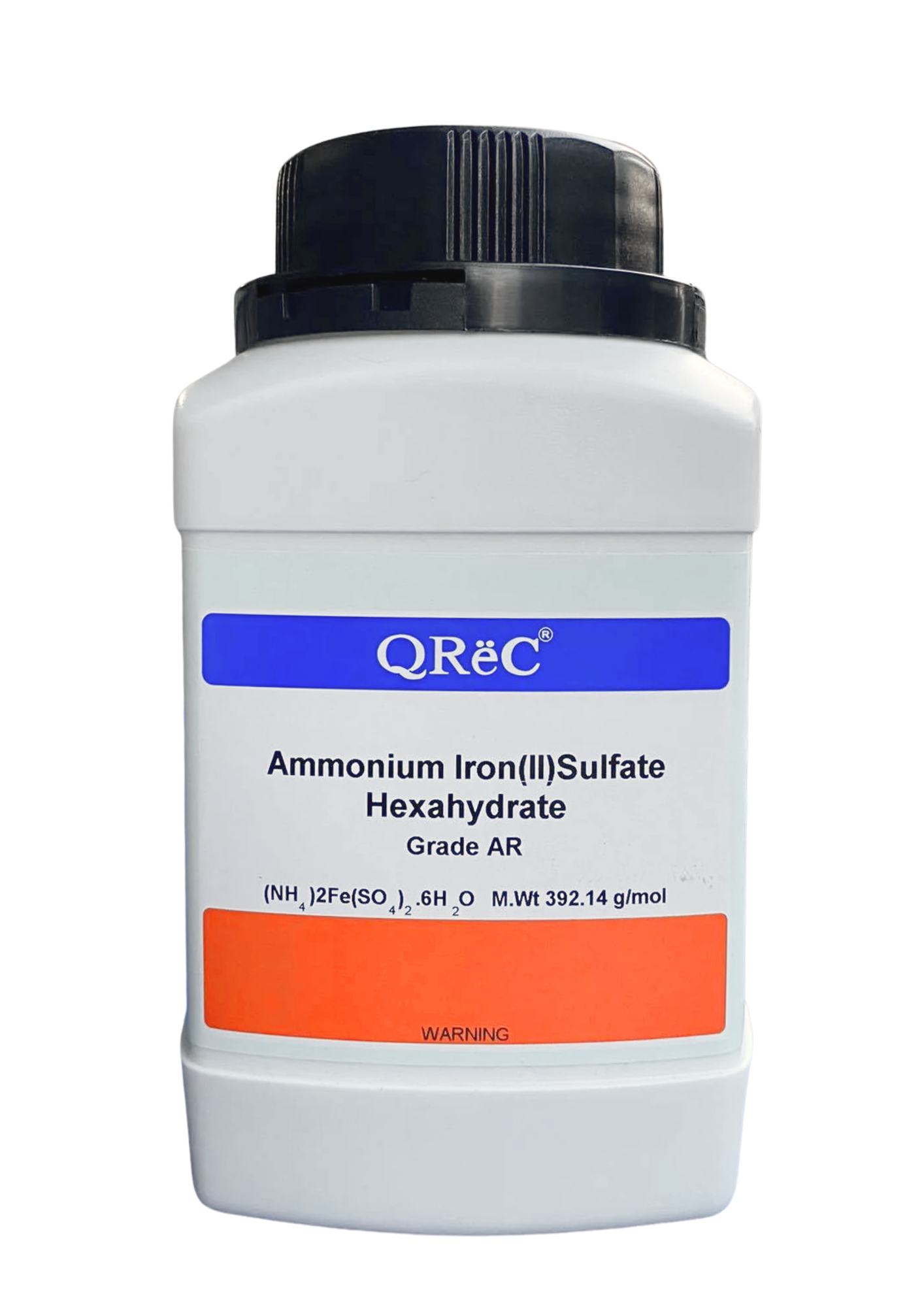
- Product Name: Ammonium ferrous sulfate hexahydrate 99.8% or Mohr’s salt or Ammonium iron (II) sulfate hexahydrate or Diammonium iron disulfate hexahydrate
- Brand: QReC (Product Code: QR-A5086-1-0500)
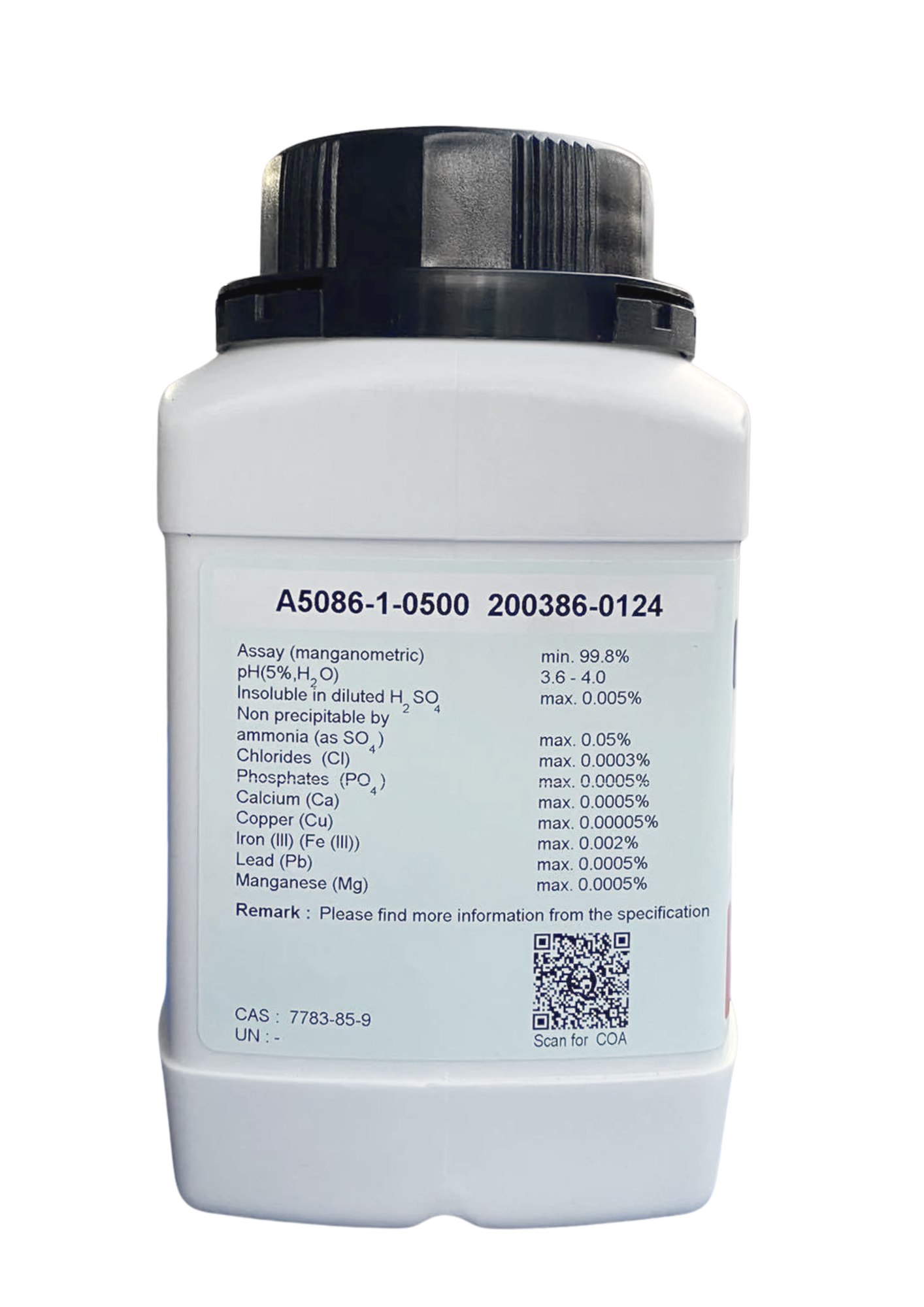
- Grade: Analytical Reagent High Purity Grade (AR Grade) featuring an exceptional certified chemical assay of not less than 99.8 percent in a 500 g laboratory container. Manufactured and multi-recrystallized under strict QReC global laboratory specifications without anti-caking additives, maintaining stoichiometric hexahydrate crystalline hydration. Strictly analyzed to enforce an ultra-low threshold of oxidized ferric iron (Iron III strictly below 0.01 percent) and water-insoluble matter below 0.005 percent, alongside minimal ppm limits of chloride, phosphate, manganese, copper, zinc, calcium, magnesium, sodium, potassium, and lead. Uniform, dry pale-green monoclinic prisms dissolve cleanly in water to yield crystal-clear, sediment-free light-green solutions. Packaged in a heavy-duty, moisture-barrier polymer container equipped with an airtight hermetic seal to prevent atmospheric oxidation.
- Physical Properties: Pale blue-green to pastel sea-green translucent crystals or fine crystalline powder. Odorless with an astringent, metallic saline taste. Considerably more resistant to atmospheric oxidation than simple ferrous sulfate salts; however, prolonged exposure to ambient air and direct sunlight induces slow superficial oxidation to basic ferric species. Non-combustible inorganic double salt. Aqueous solutions are mildly acidic (pH approximately 3.5 to 5.0 for a 5 percent aqueous solution at room temperature) and gradually turn turbid from hydrolysis unless stabilized with dilute sulfuric acid.
- Solubility: Readily and highly soluble in water (approximately 26 to 28 grams per 100 milliliters at 20 degrees Celsius, escalating to over 70 grams per 100 milliliters in boiling water; standard analytical protocols require dissolving in water acidified with dilute sulfuric acid to suppress aerial oxidation); practically insoluble in ethanol, diethyl ether, and acetone.
- Key Use: Universally utilized as the standard titrant for the classic back-titration of residual potassium dichromate in the standardized determination of Chemical Oxygen Demand (COD) in environmental water and industrial wastewater matrices, delivering a razor-sharp redox endpoint color shift with ferroin indicator. Heavily applied as a dependable Primary Standard in analytical redox titrations for standardizing powerful oxidizing titrants, including potassium permanganate, potassium dichromate, and cerium(IV) sulfate. Serves as the quintessential chemical dosimeter in the Fricke Dosimeter system for nuclear physics, radiation processing, and radiobiology, accurately measuring absorbed doses of high-energy gamma rays and X-rays via the stoichiometric radiation-induced oxidation of ferrous to ferric ions. Extensively employed in materials science as an iron precursor for synthesizing coordination compounds, as a textile mordant, and in Advanced Oxidation Processes (AOPs) as a Fenton’s reagent catalyst. Functions as an analytical reference standard for calibration in iron spectrophotometry and clinical diagnostics.
Safety & Hazards (Skin & Serious Eye Irritation, Respiratory Irritant)
- Classification: Causes skin irritation (Skin Irritation Category 2). Causes serious eye irritation (Eye Irritation Category 2). May cause respiratory irritation (Specific Target Organ Toxicity – Single Exposure Category 3).
- Health Risks: Direct ocular contact triggers acute stinging pain, conjunctival redness, corneal irritation, and lacrimation. Prolonged or repeated dermal contact can cause localized dryness, erythema, or superficial contact irritation. Inhalation of particulate dust irritates the mucous membranes of the respiratory tract, inducing sneezing, coughing, and throat dryness. Ingestion of substantial quantities provokes acute gastrointestinal irritation, sharp metallic taste, epigastric pain, nausea, vomiting, diarrhea, dark stools, and systemic iron overload toxicity affecting hepatic and cardiovascular systems.
- First Aid Measures: Immediately flush affected eyes with an abundant stream of clean flowing water for at least 15 minutes while stripping contaminated clothing; remove contact lenses promptly and seek medical attention if irritation persists. Wash exposed skin thoroughly with soap and water. In case of dust inhalation, relocate the individual to fresh air. If accidentally swallowed in substantial amounts, rinse mouth thoroughly, administer water in moderate amounts, and seek medical advice promptly.
Handling & Storage
- Storage: Light-Sensitive, Air-Sensitive Ferrous Double Salt. Atmospheric moisture and actinic light accelerate oxidation to insoluble ferric complexes. Must be preserved in its original, tightly closed QReC container. Store in a clean, strictly dry, cool, and well-ventilated dedicated chemical store at controlled temperatures (below 25 to 30 degrees Celsius), sheltered from atmospheric humidity and direct sunlight. Keep strictly segregated from strong oxidizing agents (such as peroxides, perchlorates, and permanganates) and strong caustic alkalis (which precipitate iron hydroxides and liberate pungent ammonia gas).
- Precautions: Standard laboratory PPE is mandatory, including protective nitrile gloves, splash-proof safety glasses, and a protective lab coat. “Technical Recommendation: When compounding standard volumetric solutions, acidify the deionized water with dilute sulfuric acid prior to dissolving Mohr’s salt to inhibit spontaneous aerial oxidation and hydrolysis.” Re-seal container cap tightly immediately after sampling. Minimize dust generation during weighing and dispensing.