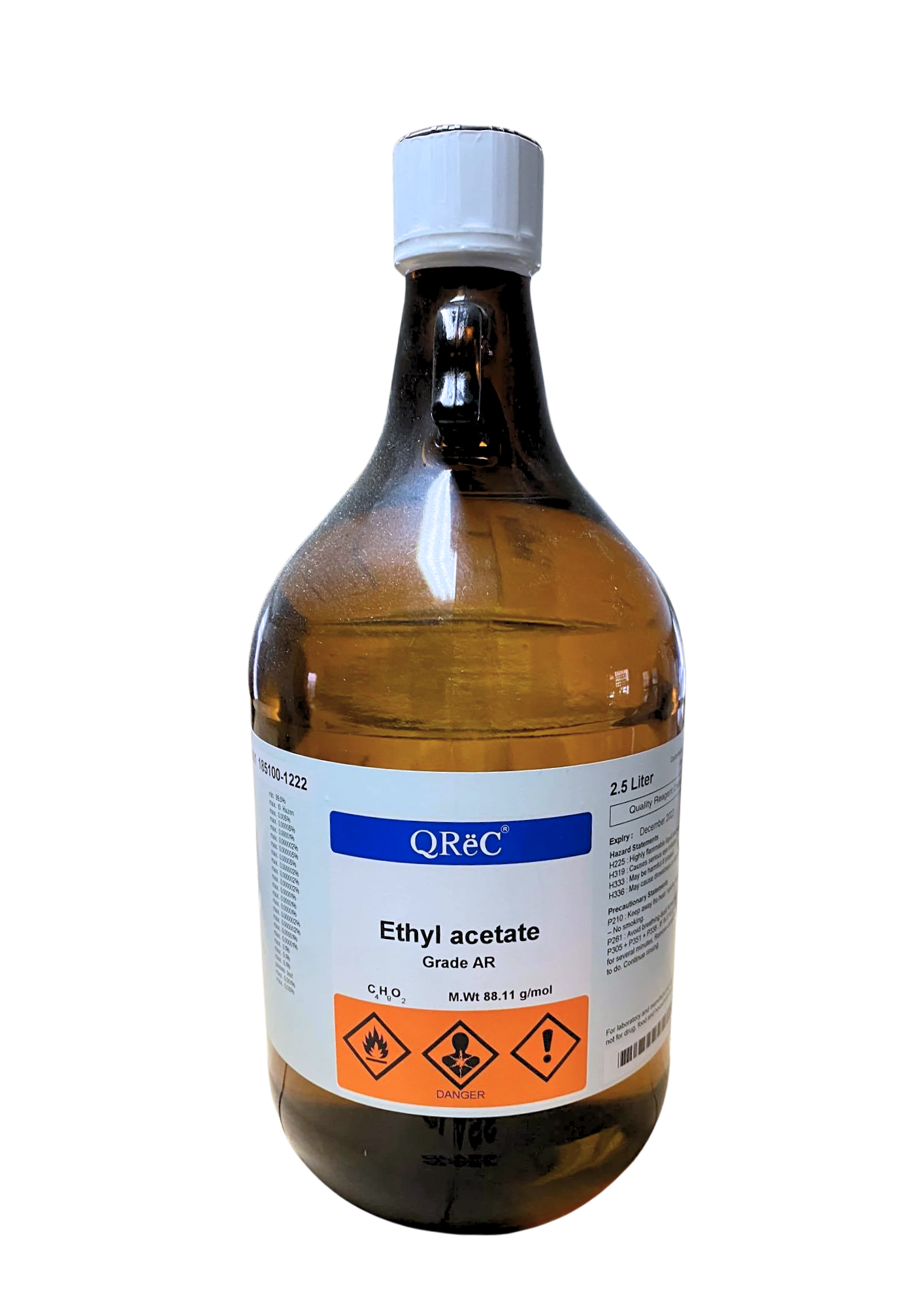
Ethyl acetate 99.5% or Ethyl ethanoate
Product Overview & Quality
- Product Name: Ethyl acetate 99.5% or Ethyl ethanoate
- Brand: QReC (Product Code: QR-E7100-1-2501)
- Grade: Analytical Reagent (AR Grade) featuring a certified chemical purity of 99.5 percent or higher. Manufactured and distilled under strict QReC global laboratory standards. Rigorously regulated to enforce exceptionally low ppm levels of non-volatile matter, water content, free acidity (as acetic acid), free ethanol, and heavy metals. This high-purity profile prevents residual contamination upon evaporation and eliminates background baseline disturbances in chromatographic and spectroscopic testing. Packaged in a heavy-duty amber glass bottle for maximum chemical integrity and light protection.
- Physical Properties: Clear, colorless, highly mobile liquid with a characteristic sweet, fruity, pleasant odor (similar to nail polish remover). Highly volatile at room temperature. Highly flammable liquid and vapor with a low flash point; vapors are denser than air and can travel along ground surfaces.
- Solubility: Moderately soluble in water (approximately 8 grams per 100 milliliters at room temperature); completely miscible in all proportions with common organic solvents including ethanol, methanol, acetone, diethyl ether, chloroform, and toluene.
- Key Use: Heavily utilized as a primary medium-polarity solvent for liquid-liquid extraction workflows to isolate active pharmaceutical ingredients, antibiotics, agrochemicals, pesticides, and botanical antioxidants from aqueous and biological matrices. Widely applied as a mobile phase eluent or modifier in thin-layer chromatography (TLC) and preparative column chromatography, frequently paired with hexane or dichloromethane. Commonly employed as an organic recrystallization solvent for purification synthesis. Routinely applied as an effective residue-free degreaser and cleaning solvent for laboratory apparatus and substrate surfaces.
Safety & Hazards (Flammable & Irritant)
- Classification: Highly flammable liquid and vapor. Causes serious eye irritation. May cause drowsiness or dizziness. Repeated exposure may cause skin dryness or cracking.
- Health Risks: Direct ocular contact triggers rapid, severe stinging irritation, redness, and tearing. Repeated dermal contact extracts natural protective skin lipids, resulting in dryness, redness, and cracking. Inhalation of concentrated vapors irritates the mucous membranes of the respiratory tract and depresses the central nervous system, inducing headaches, dizziness, nausea, lightheadedness, or drowsiness. Ingestion produces gastrointestinal irritation and nausea.
- First Aid Measures: Immediately flush affected eyes or skin with plenty of continuous flowing water for at least 15 minutes while stripping contaminated garments. In case of inhalation causing dizziness, move the individual to fresh air promptly. If accidentally swallowed, rinse mouth thoroughly, drink water, and seek medical advice.
Handling & Storage
- Storage: Highly Flammable and Volatile Solvent. Low flash point creates significant fire hazards; vapors easily migrate to distant ignition sources. Must be preserved in its original, tightly closed QReC amber glass bottle inside an approved safety cabinet for flammable liquids. Store in a cool, dry, and excellently ventilated chemical warehouse or storage room at stable room temperature (below 30 degrees Celsius), sheltered from direct sunlight. Keep strictly segregated from open flames, sparks, hot surfaces, static electricity, strong oxidizers, strong acids, and strong bases (which catalyze ester hydrolysis).
- Precautions: Standard laboratory PPE is mandatory, including solvent-resistant chemical gloves, splash-proof safety goggles, and a protective lab coat. Handle exclusively and strictly within a properly functioning laboratory fume hood to prevent vapor accumulation and inhalation exposure.