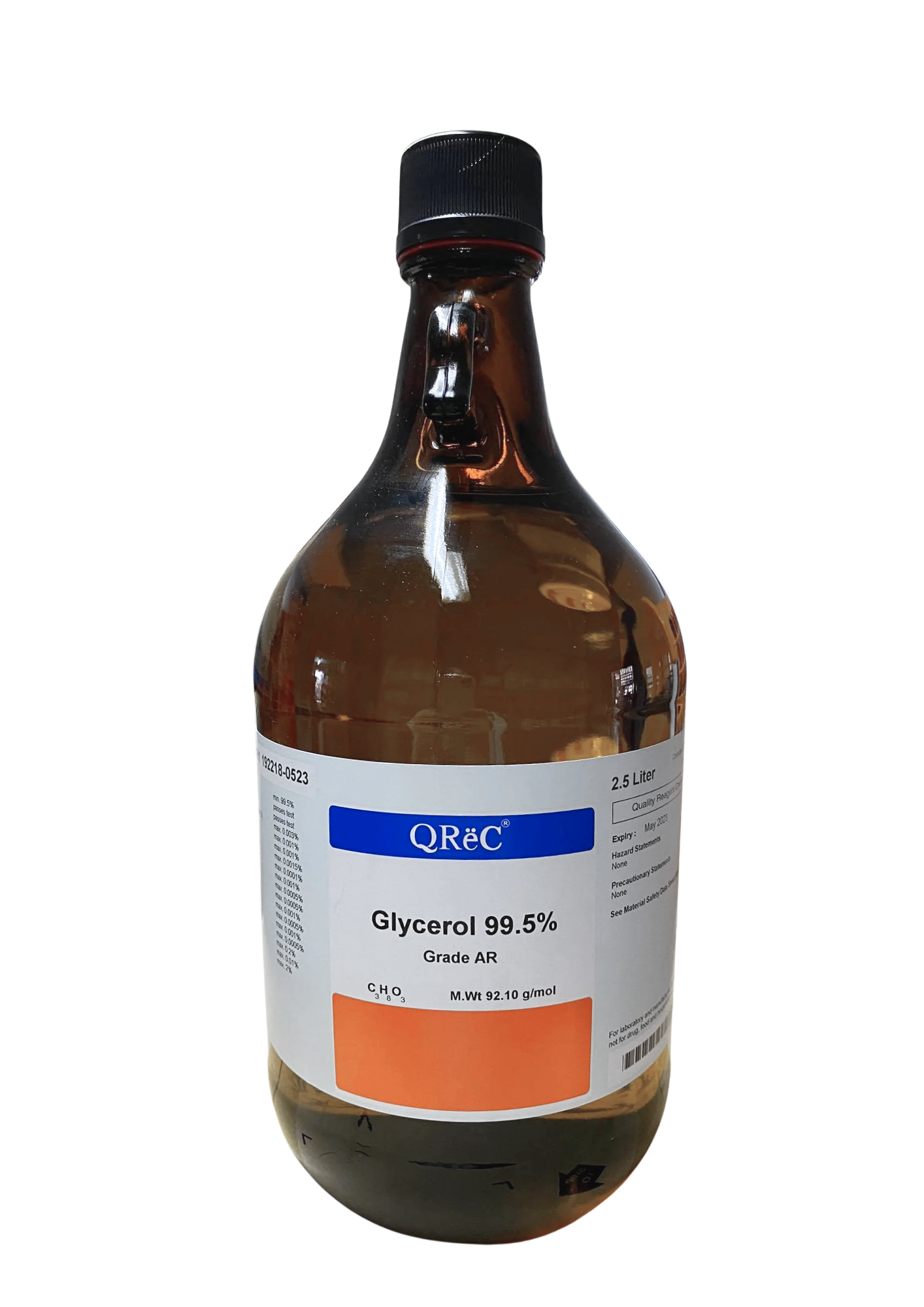
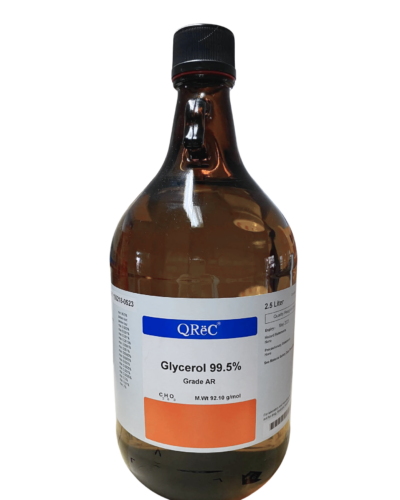
Glycerol 99.5% or Glycerin or Glycerine or Propane-1,2,3-triol or 1,2,3-Propanetriol
Product Overview & Qualit
- Product Name: Glycerol 99.5% or Glycerin or Glycerine or Propane-1,2,3-triol or 1,2,3-Propanetriol
- Brand: QReC (Product Code: QR-G4018-1-2500)
- Grade: Analytical Reagent (AR Grade) featuring a high certified chemical assay of not less than 99.5 percent. Manufactured and refined under strict QReC global laboratory specifications. Rigorously analyzed to maintain ultra-low ppm limits of moisture content (strictly below 0.5 percent), residue on ignition, chloride, sulfate, free acidity, esters, acrolein, and trace heavy metals (such as iron, lead, copper, and arsenic). Conforms to certified DNase, RNase, and Protease-free specifications, ensuring biological inertness in nucleic acid and protein research. High optical clarity with low ultraviolet background absorbance across critical spectroscopic wavelengths. Packaged in a heavy-duty, moisture-barrier polymer container equipped with a secure hermetic seal.
- Physical Properties: Clear, colorless, highly viscous, syrupy liquid. Practically odorless with a characteristic sweet taste. Strongly hygroscopic, readily absorbing atmospheric moisture. Very high boiling point (approximately 290 degrees Celsius) with negligible ambient volatility. Combustible liquid with a high flash point (exceeding 160 degrees Celsius). Non-corrosive and non-toxic. Neutral aqueous solution.
- Solubility: Completely miscible in all proportions with water and ethanol; soluble in methanol; practically insoluble in diethyl ether, benzene, chloroform, carbon tetrachloride, and hydrocarbon oils.
- Key Use: Heavily utilized as a primary cryoprotectant in molecular biology and microbiology for preserving bacterial glycerol stocks, yeast cultures, cell lines, restriction enzymes, and purified protein solutions at minus 20 to minus 80 degrees Celsius, effectively suppressing ice crystal nucleation and membrane lysis. Extensively applied as a weighting and density-increasing agent in nucleic acid and protein gel loading buffers (such as agarose and polyacrylamide gel electrophoresis), facilitating clean well-loading. Functions as an enzyme stabilizing co-solvent in storage buffers to inhibit thermal denaturation. Serves as a density gradient medium in ultracentrifugation for isolating macromolecules and subcellular organelles. Widely formulated as a humectant, plasticizer, mounting medium, and viscosity modifier in histology, pharmaceutical formulation research, and cosmetic testing.
Safety & Hazards
- Classification: Non-hazardous substance under standard GHS classification criteria in routine laboratory usage. Exceptionally low acute toxicity profile; direct contact with liquid or aerosols may cause mild mechanical ocular or respiratory irritation
- Health Risks: Direct eye contact may cause transient mechanical stinging, minor conjunctival redness, or tearing. Dermal contact is non-toxic and non-irritating, producing only a sticky topical sensation. Inhalation of mists generated from high-temperature heating may induce minor respiratory tickling or coughing. Ingestion of excessive quantities is non-toxic but may cause transient nausea, headache, or mild osmotic laxative effects.
- First Aid Measures: Flush affected eyes thoroughly with clean running water for at least 10 to 15 minutes. Wash exposed skin with soap and water. In case of mist inhalation, transfer the individual to fresh air. If accidentally swallowed in substantial amounts, rinse mouth, drink water, and seek medical advice if discomfort persists.
Handling & Storage
- Storage: Highly Hygroscopic Organic Polyol. Prolonged ambient exposure leads to water absorption, compromising analytical purity, viscosity, and cryoprotective concentrations. Must be preserved in its original, tightly closed QReC container. Store in a clean, cool, dry, and well-ventilated dedicated chemical store at controlled temperatures (below 25 to 30 degrees Celsius), sheltered from atmospheric humidity and direct sunlight. Keep strictly segregated from strong oxidizing agents (such as solid potassium permanganate, concentrated nitric acid, and chromium trioxide, which can trigger violent spontaneous combustion upon contact), strong mineral acids, and open flames.
- Precautions: Standard laboratory PPE is mandatory, including protective gloves, safety glasses, and a protective lab coat. Re-seal container cap tightly immediately after sampling to prevent moisture uptake. Wipe bottle necks clean after dispensing to prevent sticky residue accumulation.