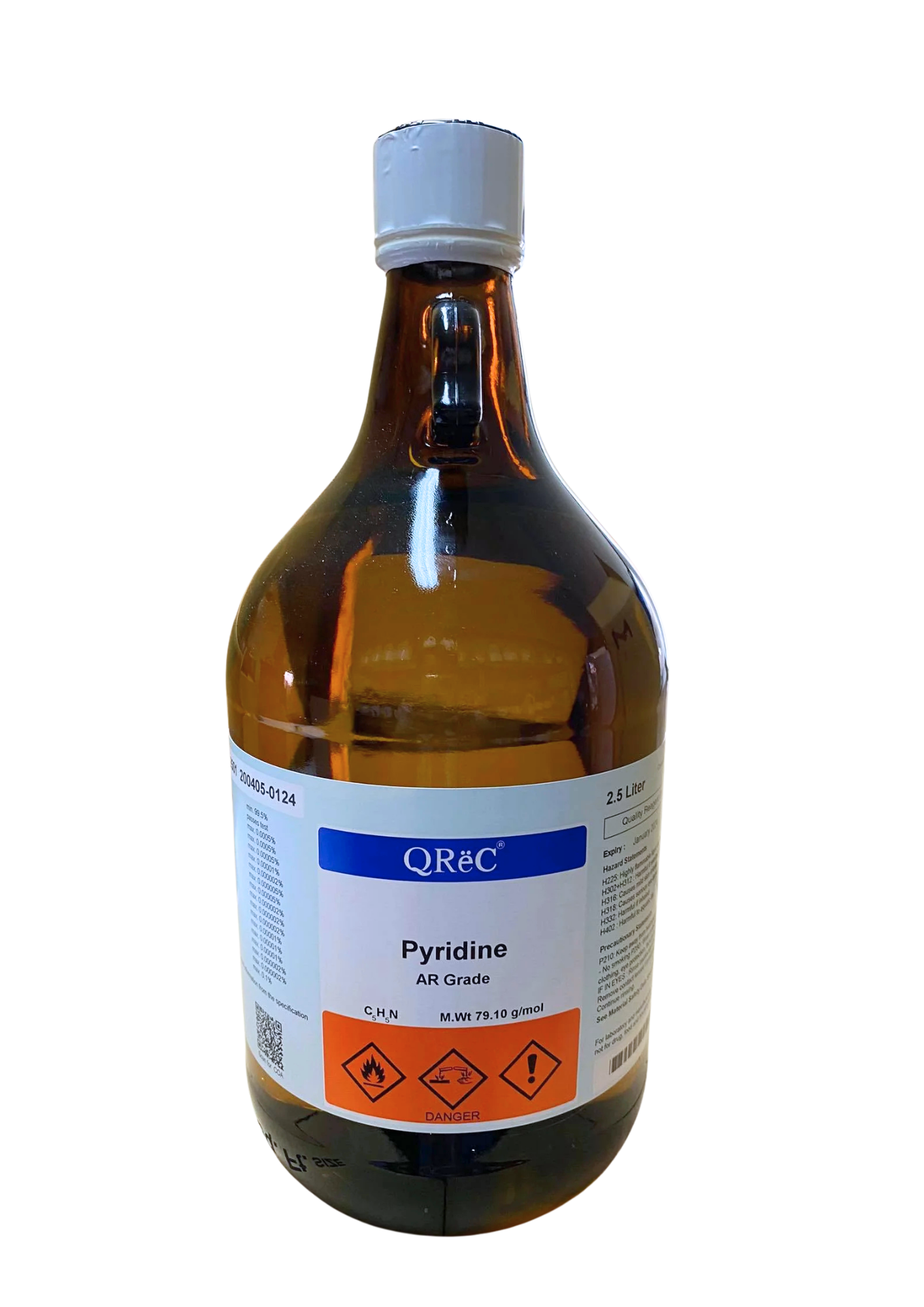
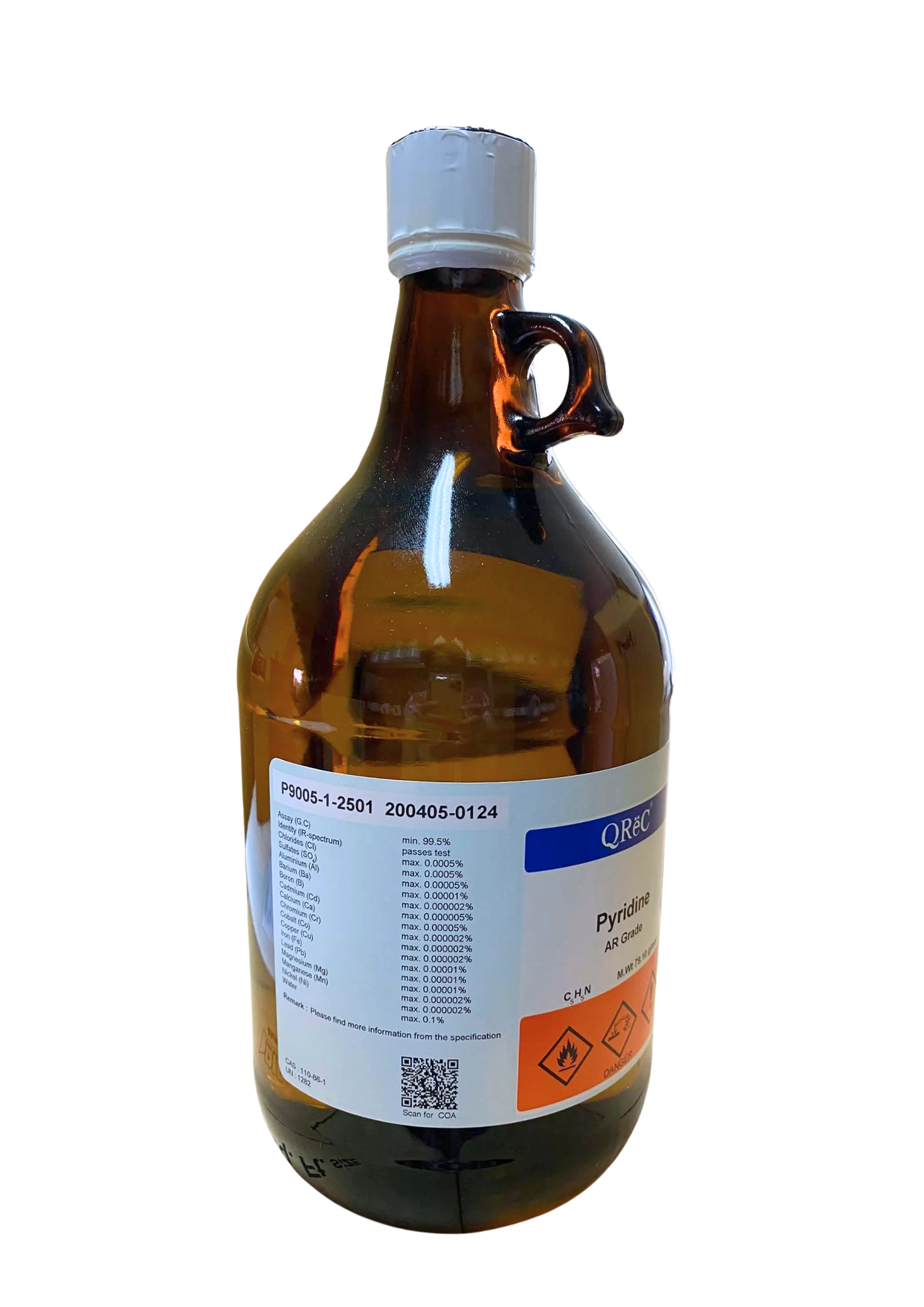
Azabenzene or Azine or Azacyclohexatriene
Product Overview & Quality
- Product Name: Pyridine 99.5% or Azabenzene or Azine or Azacyclohexatrien
- Brand: QReC (Product Code: QR-P9005-1-2501)
- Grade: Analytical Reagent High Purity Grade (AR Grade) featuring an exceptional certified chemical assay of not less than 99.5 percent in a 2,500 mL (2.5 L) Winchester amber glass bottle. Purified and rectified under strict QReC global laboratory specifications to ensure high baseline consistency for sensitive analytical and synthetic protocols. Water and moisture content are rigorously controlled below 0.1 percent. Non-volatile evaporation residue is strictly maintained below 0.002 percent, with trace chloride, sulfate, ammonia compounds, picolines, and heavy metals (such as lead, iron, copper, arsenic, and zinc) restricted to ultra-low ppm limits. Crystal-clear, particulate-free organic base packaged in a heavy-duty, solvent-resistant amber glass container fitted with a double-seal tamper-evident safety closure designed to contain offensive vapors.
- Physical Properties: Clear, colorless to faintly yellowish mobile liquid. Pungent, penetrating, nauseating, characteristic amine-fishy odor with a very low olfactory threshold. Boiling point is approximately 115 degrees Celsius. Closed-cup flash point is approximately 17 to 20 degrees Celsius. Classified as a highly flammable liquid and vapour (Flammable Liquids Category 2). Hygroscopic liquid, readily absorbing atmospheric moisture. Aqueous solutions are mildly basic (pH approximately 8.5 for a 5 percent aqueous solution at room temperature). Chemically stable aromatic heterocyclic core, significantly more resistant to oxidation than benzene.
- Solubility: Completely miscible in all proportions with water; completely miscible with virtually all organic solvents, including ethanol, methanol, diethyl ether, chloroform, acetone, benzene, and petroleum ether. Exhibits excellent solvency toward diverse polar/non-polar organic compounds and inorganic coordination salts.
- Key Use: Universally utilized as a classical organic base and acid scavenger in synthetic organic chemistry, driving acylation, alkylation, and esterification reactions by scavenging liberated hydrochloric acid and activating carbonyl centers (such as in nucleophilic acyl substitutions). Serves as an essential basic component and solvent in classical Karl Fischer reagent formulations for the precise coulometric and volumetric determination of trace water content across pharmaceuticals, chemicals, oils, and foodstuffs. Extensively applied as a vital synthetic precursor and intermediate for manufacturing active pharmaceutical ingredients (APIs), herbicides/pesticides (such as paraquat and diquat), vitamins (niacin/vitamin B3), and pyridine derivatives. Heavily employed as an aromatic monodentate nitrogen-donor ligand in coordination chemistry for preparing transition metal complexes for catalysis and spectroscopy. Routinely used as an extractive and reaction solvent for dissolving refractory polymers, resins, and in specialty chromatographic assays.
Safety & Hazards (Highly Flammable, Acute Toxicity, Severe Odor & Target Organ Effects)
- Classification: Highly flammable liquid and vapour (Flammable Liquids Category 2). Harmful if swallowed, in contact with skin or if inhaled (Acute Toxicity Oral/Dermal/Inhalation Category 4). Causes skin irritation (Skin Irritation Category 2). Causes serious eye irritation (Eye Irritation Category 2). Suspected of causing cancer.
- Health Risks: Highly irritating and noxious vapor. Direct ocular contact triggers acute burning pain, conjunctival injection, corneal edema, and lacrimation. Dermal contact produces localized erythema, burning, scaling, contact dermatitis, and rapid systemic percutaneous absorption. Inhalation of concentrated vapors aggressively irritates the respiratory tract, inducing coughing, choking, throat tightness, severe headaches, vertigo, nausea, vomiting, nervousness, and central nervous system depression. Critical Chronic Target Organ Toxicity: Repeated or prolonged occupational exposure causes severe toxic hepatitis (liver damage), acute tubular necrosis (kidney damage), and hematopoietic marrow disturbances. Ingestion produces violent gastrointestinal inflammation, burning of the mouth and esophagus, abdominal cramps, nausea, vomiting, dizziness, and circulatory collapse.
- First Aid Measures: Immediately flush affected eyes with an abundant stream of clean flowing water for at least 15 to 20 minutes while stripping contaminated clothing; remove contact lenses promptly and seek immediate ophthalmological attention. Wash exposed skin thoroughly with soap and water for at least 15 minutes. In case of vapor inhalation, rapidly relocate the victim to fresh air; keep warm and at rest, and seek prompt medical attention. If accidentally swallowed, do NOT induce vomiting; thoroughly rinse mouth, administer moderate quantities of fresh water to dilute, and transport to an emergency medical facility immediately.
Handling & Storage
- Storage: Highly Flammable, Penetratingly Odorous, Hepatotoxic, and Nephrotoxic Liquid. Volatile vapors pose immediate fire hazards and pervasive odor contamination. Must be preserved in its original, tightly closed QReC amber glass container. Store in an approved, grounded flammable liquids storage cabinet within a clean, cool, dry, and well-ventilated dedicated chemical store at controlled temperatures (preferably below 25 degrees Celsius), sheltered from direct sunlight, open flames, sparks, and static discharge. Keep strictly segregated from strong oxidizing agents (such as nitric acid, perchlorates, chromic acid, and hydrogen peroxide), strong concentrated mineral acids (violent exothermic neutralization yields pyridinium salts), acid anhydrides, and halogens.
- Precautions: Comprehensive specialized PPE is mandatory, including chemical-resistant gloves (butyl rubber is strongly recommended; thin disposable nitrile offers minimal breakthrough protection), splash-proof safety goggles, an organic vapor respirator, and a protective lab coat. “Mandatory Protocol: Transfer, dispense, and handle pyridine exclusively and strictly within a certified, properly functioning laboratory fume hood to prevent indoor air contamination and eliminate chronic inhalation risks.” Keep dry chemical or carbon dioxide fire extinguishers accessible. Never discharge pyridine rinsates or wastes into municipal sewers; collect in dedicated halogenated/nitrogenous organic solvent hazardous waste streams.