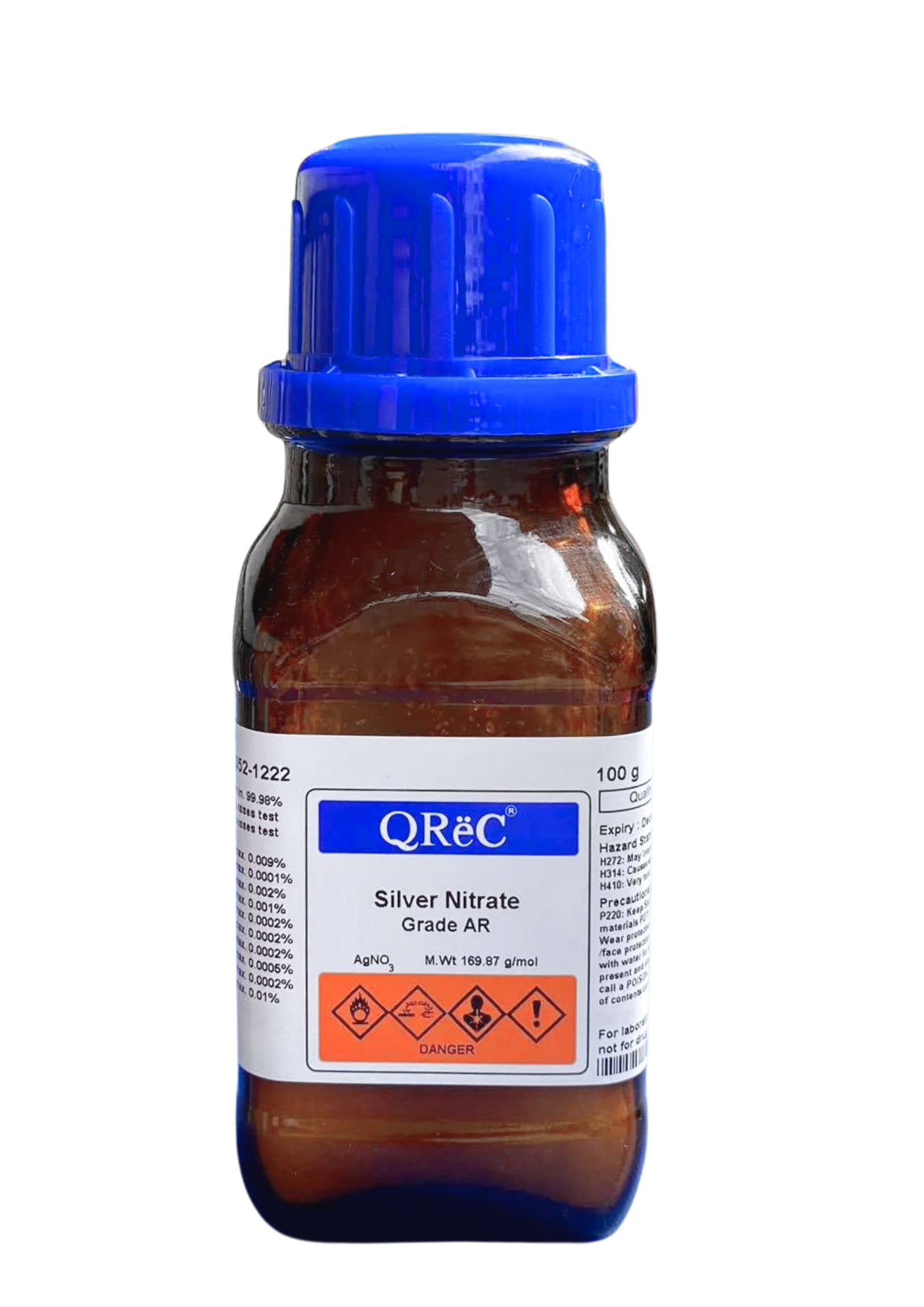
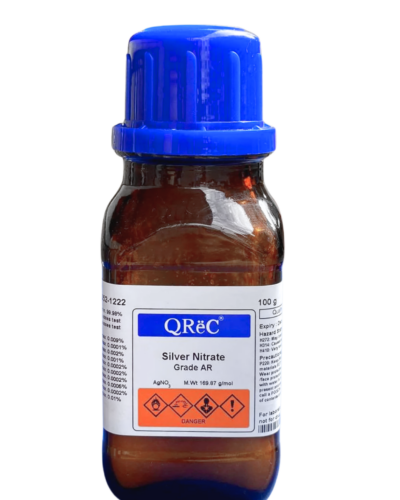
Silver nitrate 99.98% or Silver mononitrate or Lunar caustic
Product Overview & Quality
- Product Name: Silver nitrate 99.98% or Silver mononitrate or Lunar caustic
- Brand: QReC (Product Code: QR-S3052-1-0101)
- Grade: Ultra-pure Analytical Reagent (Ultra-pure AR Grade) featuring an exceptional certified chemical assay of 99.98 percent or higher. Produced and multi-crystallized under rigorous QReC global laboratory specifications. Strictly monitored to enforce minimal ppm thresholds of chloride, sulfate, nitrite, and trace heavy metals (such as lead, copper, iron, bismuth, and zinc). Dry, moisture-free crystals yield completely clear, precipitate-free aqueous solutions, serving as a definitive primary volumetric standard for high-accuracy titrations without preliminary standardization. Packaged in a specialized heavy-duty amber glass bottle for maximum chemical integrity and light protection.
- Physical Properties: Colorless, transparent crystalline solid or white crystalline powder. Odorless. Extremely sensitive to light and ultraviolet radiation, gradually turning grey or black upon photoreduction to metallic silver. Non-combustible alone, but acts as an oxidizer that can intensify combustion in surrounding flammable materials.
- Solubility: Highly soluble in water (solubility increases rapidly with rising temperature); soluble in ethanol, aqueous ammonia, and polar reaction media.
- Key Use: Heavily utilized as the primary reference standard in precipitation titrations (Argentometric titration methods, including Mohr and Volhard titrations) for accurate quantification of chloride, bromide, and iodide in water, food, fertilizers, and pharmaceutical samples. Widely applied in qualitative inorganic analysis for halide confirmation. Extensively employed in molecular biology and biochemistry for ultra-sensitive silver staining of proteins and nucleic acids in polyacrylamide gel electrophoresis (PAGE / SDS-PAGE), offering drastically higher sensitivity than standard Coomassie staining. Used to prepare freshly formulated Tollens reagent for detecting aldehydes and reducing sugars in organic chemistry, and serves as a vital silver precursor in silver nanoparticle synthesis and material science research.
Safety & Hazards (Critical, Oxidizer, Corrosive & Aquatic Toxic)
- Classification: May intensify fire; oxidizer. Causes severe skin burns and eye damage. Causes serious eye damage. Harmful if swallowed. Very toxic to aquatic life with long lasting effects.
- Health Risks: Direct eye contact causes catastrophic necrotic ulceration of the conjunctiva and cornea, resulting in severe pain, corneal opacification, and permanent blindness. Dermal exposure causes severe caustic burns and forms indelible, black, insoluble silver proteinate stains on the skin (Argyria) that persist for weeks until epidermal shedding occurs. Inhalation of dust or aerosols severely corrodes the respiratory tract, provoking coughing, dyspnea, chemical bronchitis, and acute pulmonary edema. Ingestion induces severe caustic destruction of the mouth, esophagus, and stomach, accompanied by intense abdominal pain, vomiting, and systemic silver poisoning.
- Special Incompatibility Hazard: Ammoniacal silver solutions (such as aged Tollens reagent) can spontaneously form fulminating silver complexes (silver nitride), which are contact-sensitive high explosives.
- First Aid Measures: Immediately flush affected eyes or skin with plenty of continuous flowing water for at least 15 minutes while stripping contaminated clothing. In case of dust inhalation, rapidly transfer the victim to fresh air. If accidentally swallowed, do NOT induce vomiting; thoroughly rinse mouth, administer water or milk, and seek immediate, urgent emergency medical attention.
Handling & Storage
- Storage: Highly Light-Sensitive and Strong Oxidizer. Decomposes into metallic silver, oxygen, and toxic nitrogen dioxide gas under exposure to light or thermal sources. Must be preserved in its original, tightly closed QReC amber glass bottle. Store in a cool, dry, excellently ventilated chemical cabinet maintained in complete darkness at controlled temperatures (preferably below 25 to 30 degrees Celsius). Keep strictly isolated from direct sunlight, thermal sources, organic matter, alcohols, combustible materials, strong reducing agents, and concentrated ammonia.
- Precautions: Standard laboratory PPE is mandatory, including nitrile chemical-resistant gloves, splash-proof safety goggles, and a protective lab coat. Avoid contact with skin or clothing to prevent persistent dark stains. Never discard silver-containing residues into municipal drains; segregate into dedicated heavy-metal waste containers for certified disposal or silver recovery.