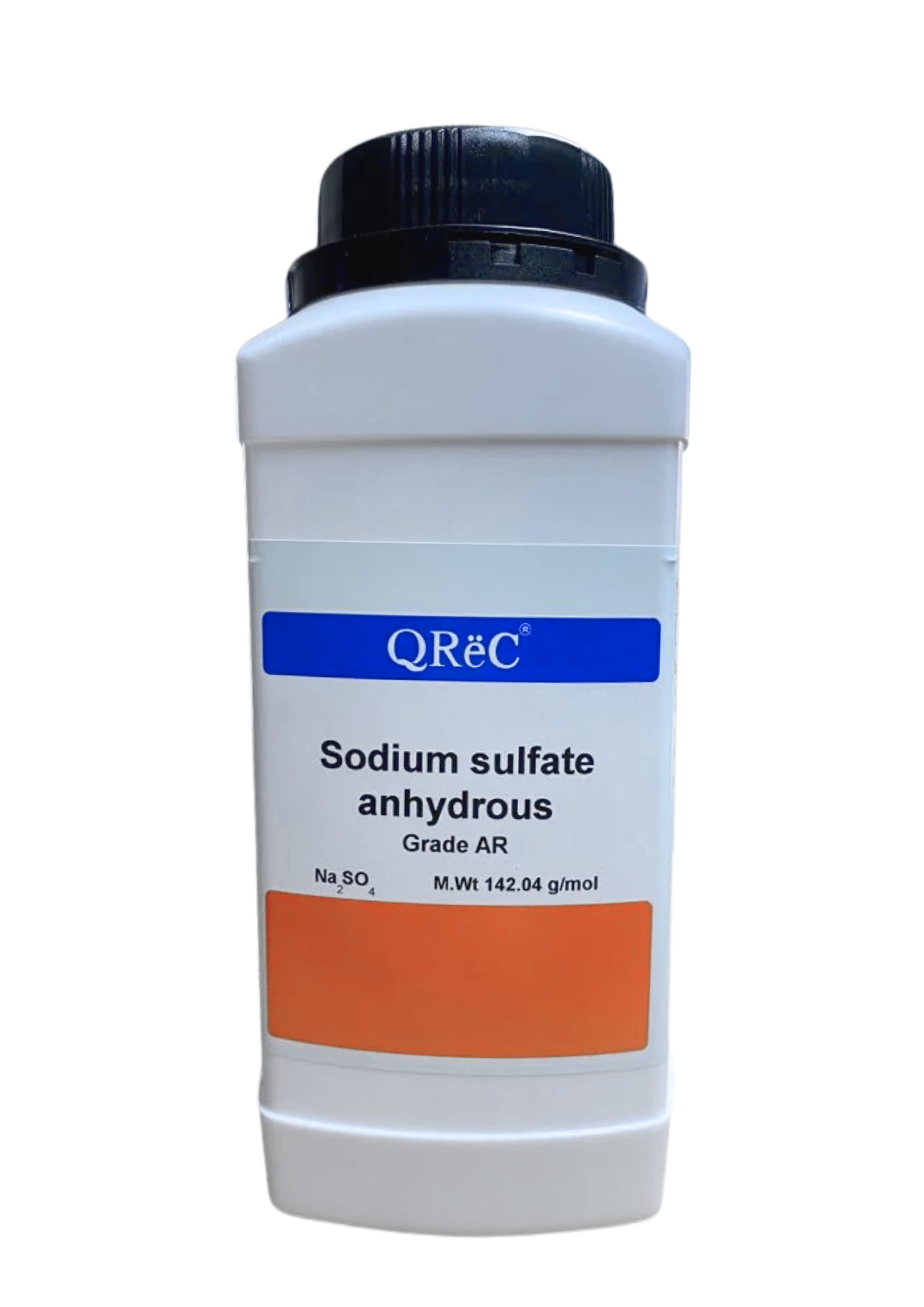
Sodium sulfate anhydrous 99% or Disodium sulfate anhydrous or Glauber salt dry
Product Overview & Quality
- Product Name: Sodium sulfate anhydrous 99% or Disodium sulfate anhydrous or Glauber salt dry
- Brand: QReC (Product Code: QR-S5281-1-1000)
- Grade: Analytical Reagent (AR Grade) featuring a high certified chemical purity of not less than 99 percent. Manufactured and rigorously dehydrated under strict QReC global laboratory standards. Formulated to ensure exceptionally low loss on ignition thresholds. Rigorously analyzed to enforce minimal ppm limits of chloride, phosphate, total nitrogen, water-insoluble matter, calcium, magnesium, and trace heavy metals (such as iron, lead, copper, zinc, and arsenic). Displays a dry, uniform granular crystal profile with high moisture-scavenging capacity, dissolving cleanly in water to produce transparent, residue-free solutions. Packaged in a heavy-duty, moisture-barrier polymer container equipped with a hermetic seal.
- Physical Properties: White crystalline powder or uniform granular crystals. Odorless. Hygroscopic under humid conditions, readily sequestering free water to form decahydrate hydrates. Aqueous solutions are practically neutral (pH approximately 5.5 to 7.5 for an aqueous solution). Non-flammable and non-corrosive.
- Solubility: Freely soluble in water (approximately 19 to 20 grams per 100 milliliters at room temperature; solubility escalates sharply with rising temperature up to approximately 32.4 degrees Celsius); soluble in glycerol; practically insoluble in ethanol.
- Key Use: Heavily utilized as the primary, inert, neutral drying agent in organic synthesis and preparative chemistry to eliminate residual water droplets and dissolved moisture from organic extracts and solvent fractions (such as ethyl acetate, dichloromethane, diethyl ether, chloroform, and hexanes) prior to rotary evaporation or distillation. Extensively applied as a boiling point elevator and salt cake builder in Kjeldahl digestion mixtures (paired with concentrated sulfuric acid) to accelerate total nitrogen and crude protein mineralizations. Universally employed for the salting-out fractionation and purification of proteins and enzymes in biochemical workflows. Serves as a neutral background electrolyte in electrochemical studies, a spectrophotometric analytical reagent, and a primary sulfate source for preparing standard calibration solutions.
Safety & Hazards
- Classification: Non-hazardous substance under standard GHS classification criteria in routine laboratory usage. Low acute toxicity profile; particulate dust may cause mild mechanical irritation to ocular, dermal, and respiratory surfaces.
- Health Risks: Direct eye contact may cause transient mechanical irritation, conjunctival redness, and tearing. Prolonged dermal exposure may cause mild dryness or superficial irritation. Inhalation of particulate dust can induce sneezing, coughing, or minor upper respiratory discomfort. Ingestion of substantial quantities may provoke transient gastrointestinal upset, abdominal cramping, or osmotic diarrhea due to the laxative effect of sulfate ions.
- First Aid Measures: Flush affected eyes thoroughly with clean running water for at least 10 to 15 minutes. Wash exposed skin with soap and water. In case of dust inhalation, transfer the individual to fresh air. If accidentally swallowed in substantial amounts, rinse mouth thoroughly, drink water, and seek medical advice if discomfort persists.
Handling & Storage
- Storage: Hygroscopic Inorganic Drying Reagent. Unsealed ambient exposure compromises anhydrous capacity through water uptake. Must be preserved in its original, tightly closed QReC container. Store in a clean, strictly dry, cool, and well-ventilated chemical store at controlled temperatures (below 25 to 30 degrees Celsius), sheltered from atmospheric humidity and direct sunlight. Keep strictly segregated from moisture, water, strong mineral acids, and strong bases.
- Precautions: Standard laboratory PPE is mandatory, including protective gloves, safety glasses, and a protective lab coat. Re-seal container cap tightly immediately after sampling to protect desiccant efficacy. Minimize dust generation during weighing and dispensing.