Oil of vitriol or Dihydrogen sulfate
Product Overview & Quality
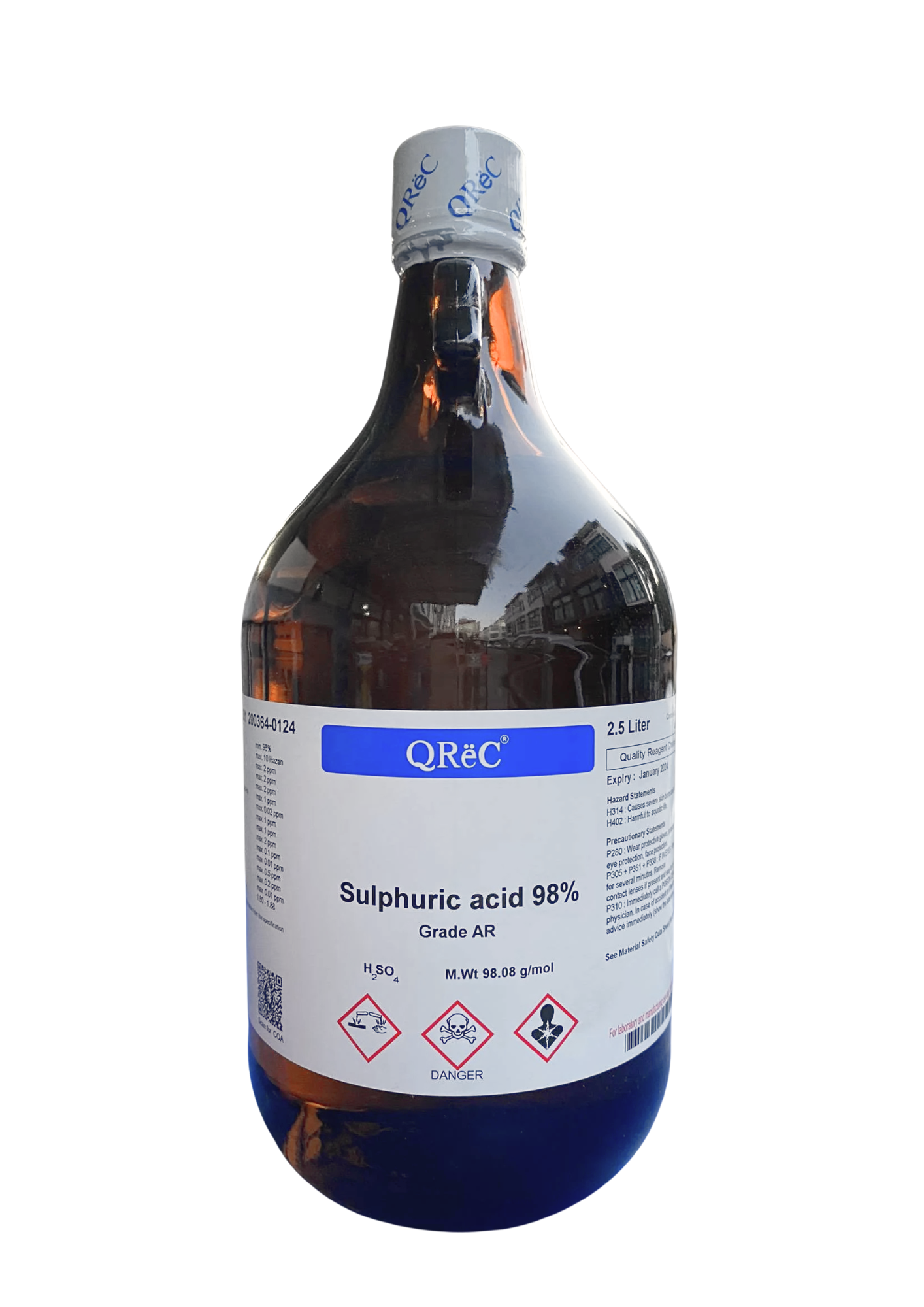
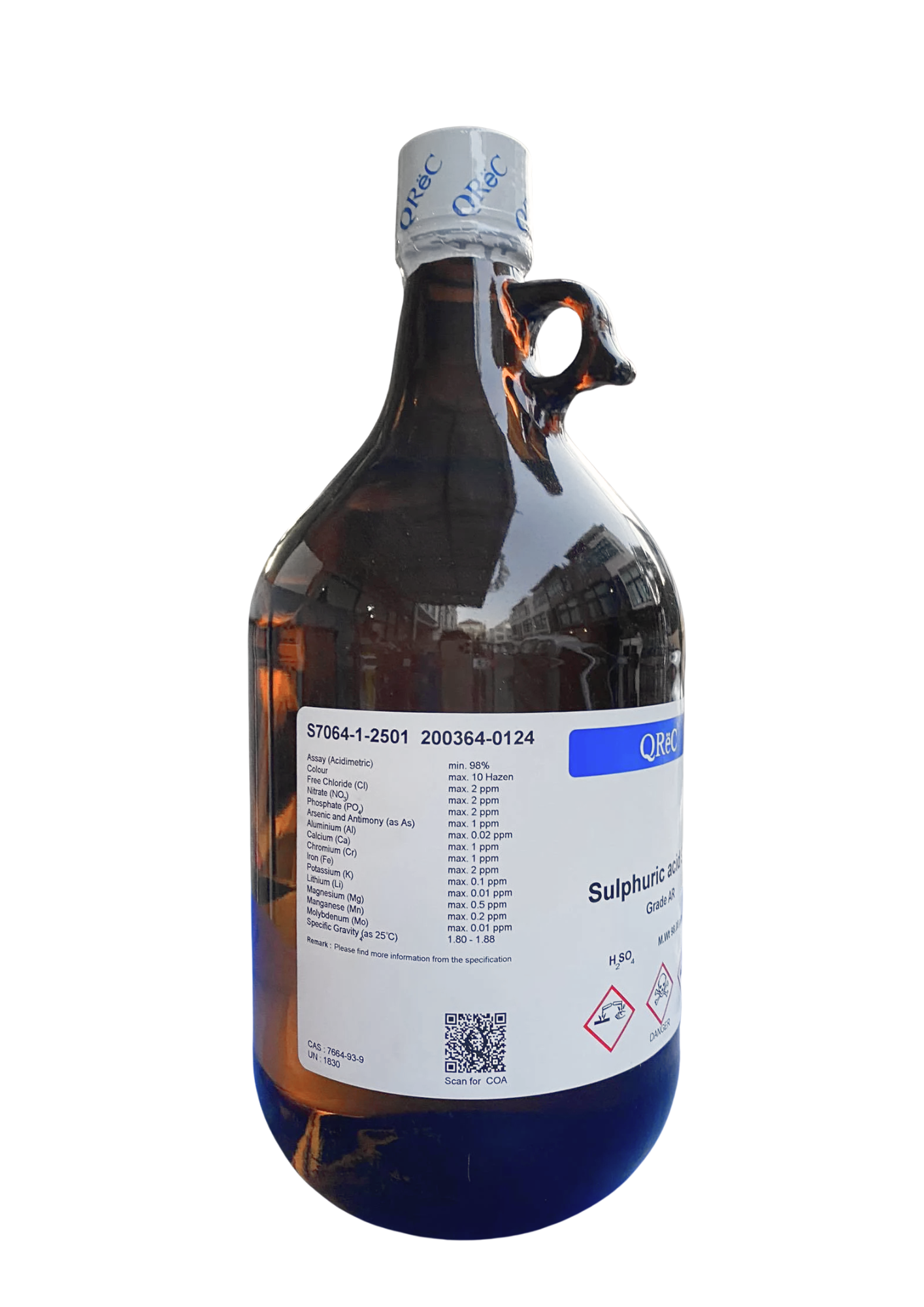
- Product Name: Sulfuric acid 98% or Oil of vitriol or Hydrogen sulfate or Dihydrogen sulfate
- Brand: QReC (Product Code: QR-S7064-1-2501)
- Grade: Analytical Reagent High Purity Grade (AR Grade) featuring an exceptional certified chemical assay of 95.0 to 98.0 percent in an industry-standard 2,500 mL (2.5 L) Winchester amber glass bottle. Purified and rectified under strict QReC global laboratory specifications. Rigorously tested to enforce an ultra-low non-volatile residue on ignition (strictly below 0.0005 percent), alongside minimal ppm thresholds of chloride, nitrate, ammonium, and phosphorus compounds. Trace heavy metals (such as iron, lead, copper, arsenic, zinc, nickel, and selenium) are tightly restricted to ultra-low ppm and sub-ppm limits. Free from organic contaminants, presenting as a crystal-clear, colorless, dense liquid that maintains clarity without discoloration. Packaged in a heavy-duty, acid-resistant amber glass bottle fitted with a double-seal safety closure designed for vapor containment.
- Physical Properties: Clear, colorless, odorless to faintly pungent, oily, and heavy viscous liquid. Extremely dense (specific gravity approximately 1.84 g/mL at 20 degrees Celsius). High boiling point of approximately 337 degrees Celsius. Non-flammable inorganic acid, but violently reactive with water, combustible substances, and organic matter. Acts as an extremely aggressive dehydrating agent, capable of rapidly charring carbohydrates and organic tissues into black elemental carbon. Aqueous matrices are strongly acidic (pH less than 1.0) and aggressively corrosive toward metals, masonry, and biological membranes.
- Solubility: Completely miscible in all proportions with water; dissolution in water is an intensely exothermic, dangerous process liberating immense thermal energy that can instantaneously vaporize water and cause violent spattering of concentrated acid. Miscible with ethanol (exothermic, with potential oxidation risk).
- Key Use: Universally utilized as the standard digestion acid in the Kjeldahl method for determining total nitrogen and crude protein across food, animal feeds, grains, soils, and fertilizers in agricultural quality control. Heavily employed in environmental analytical laboratories for the digestion and determination of Chemical Oxygen Demand (COD) in wastewater streams, formulated alongside potassium dichromate and silver sulfate catalyst. Serves as a vital industrial and synthetic acid catalyst and dehydrating medium in organic chemistry, driving esterification, sulfonation, and aromatic nitration reactions (as mixed acid paired with concentrated nitric acid). Functions as the foundational reagent for standardizing volumetric acidic solutions (such as 0.05 M, 0.1 N, and 1.0 N titrants) in neutralization titrations. Extensively applied in the wet digestion and sample dissolution of ores, minerals, metallurgical alloys, and refractory polymers for trace element analysis via atomic spectroscopy.
Safety & Hazards (Extremely Corrosive, Severe Chemical Burns & Permanent Eye Damage)
- Classification: Causes severe skin burns and eye damage (Skin Corrosion Category 1A). Causes serious eye damage (Eye Damage Category 1). May be corrosive to metals (Corrosive to Metals Category 1). Chronic occupational exposure to strong inorganic acid mists is classified as carcinogenic to humans (IARC Group 1).
- Health Risks: Direct ocular contact causes rapid, catastrophic corneal destruction, deep scleral ulceration, and irreversible blindness within seconds. Dermal contact causes immediate, excruciating full-thickness chemical burns, severe coagulative necrosis, and black charring of dermal tissue driven by rapid exothermic dehydration. Inhalation of concentrated acid mists or vapors aggressively attacks the mucous membranes of the respiratory tract, inducing choking, severe bronchospasm, coughing, pulmonary edema, and respiratory arrest. Ingestion causes catastrophic corrosion of the oral cavity, pharynx, esophagus, and stomach, frequently resulting in esophageal or gastric perforation, hypovolemic shock, and fatal peritonitis.
- First Aid Measures: Immediately flush affected eyes with an abundant, continuous stream of clean flowing water for at least 20 to 30 minutes while holding eyelids open and stripping contaminated garments; remove contact lenses promptly and seek immediate emergency ophthalmological hospitalization. Wash exposed skin immediately with torrential volumes of water for at least 15 to 20 minutes; do not apply neutralizing bases to skin. In case of mist inhalation, rapidly relocate the victim to fresh air, administer humidified supplemental oxygen if trained, and seek urgent medical resuscitation. If accidentally swallowed, do NOT induce vomiting and never administer carbonate/bicarbonate neutralizers; thoroughly rinse mouth, administer abundant cold water or milk to dilute, and transport to an emergency medical facility immediately.
Handling & Storage
- Storage: Extremely Corrosive, Violent Water-Reactive Acid. Must be preserved in its original, tightly closed QReC amber glass bottle placed inside a dedicated corrosion-proof secondary containment basin. Store in an approved, dedicated acid storage cabinet within a clean, cool, dry, and well-ventilated dedicated chemical store at controlled temperatures (below 25 degrees Celsius), sheltered from humidity and direct solar radiation. Keep strictly segregated from organic compounds, flammable solvents, strong caustic alkalis, alkali metals, oxidizing agents, reducing agents, chlorates, perchlorates, permanganates, and nitrates (mixing with incompatible oxidizers can trigger violent explosions or fires).
- Precautions: Highest level of laboratory PPE is mandatory, including heavy-duty chemical-resistant acid gloves (neoprene or butyl rubber), splash-proof safety goggles paired with a full-face shield, an acid-resistant apron, and a lab coat. “The Golden Safety Rule of Acid Compounding: ALWAYS add acid slowly down the side of the container into water with continuous stirring (Acid into Water – ‘AAA’). NEVER pour water into concentrated sulfuric acid, as rapid localized boiling will violently blast concentrated acid outward.” Dispense and manipulate concentrated acid strictly inside a certified, high-velocity laboratory fume hood. Neutralize all acidic residues carefully before disposal; never discharge unneutralized concentrated sulfuric acid into municipal sewers.