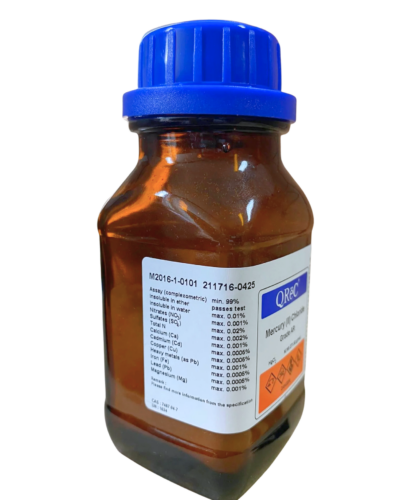
Tetrabromophenolsulfonephthalein or BPB or Bromophenol blue indicator
Product Overview & Quality
- Product Name: Bromophenol blue or 3,3′,5,5′-Tetrabromophenolsulfonphthalein or BPB or Albutest
- Brand: QReC (Product Code: QR-B6030-0-0010)
- Grade: Analytical Reagent, Indicator, and Molecular Biology Grade (AR Grade / ACS Grade) in a standard 10 g laboratory package. Synthesized, purified, and crystallized under strict QReC global laboratory specifications to ensure high chromophoric purity and distinct visual transitions. Formulated and validated for sharp acid-base indication between pH 3.0 (yellow) and pH 4.6 (blue-violet) through an intermediate greenish phase. Specific absorbance peak in dilute alkali is tightly controlled at 590 to 592 nm. Loss on drying is restricted below 1.5 percent, and sulfated ash (residue on ignition) is maintained below 0.2 percent. Certified DNase and RNase-free, ensuring non-destructive compatibility with delicate nucleic acid and protein electrophoretic protocols. Dissolves cleanly in ethanol or dilute alkali without leaving insoluble particulates. Packaged in a heavy-duty, light-protective amber container fitted with an airtight hermetic seal.
- Physical Properties: Fine orange-pink, brownish-orange, or dark reddish-purple crystalline powder. Odorless. Thermodynamically stable in air under ambient laboratory conditions; non-volatile solid with combustible characteristics under high thermal stress. Solutions exhibit reversible halochromism, transitioning between a neutral sultone yellow form in acidic environments and a fully conjugated quinoid dianion deep blue-violet chromophore in alkaline systems.
- Solubility: Sparingly soluble in cold water at room temperature (approximately 0.4 grams per 100 milliliters); freely soluble in ethanol, methanol, methyl cellosolve, and dilute aqueous sodium hydroxide solutions (forming the water-soluble sodium salt); slightly soluble in diethyl ether and benzene.
- Key Use: Universally utilized as the standard tracking dye and electrophoretic migration marker in DNA and RNA loading buffers for agarose gel electrophoresis; in a standard 1 percent agarose gel, it comigrates approximately with double-stranded DNA fragments between 300 and 500 base pairs, allowing real-time visual tracking of sample progression. Extensively applied as the leading ion dye in Laemmli sample buffer for polyacrylamide gel electrophoresis (SDS-PAGE) to visualize the moving electrophoretic front and establish the endpoint of protein separation. Heavily employed as a volumetric pH indicator in acid-base titrations terminating within acidic ranges (pH 3.0 to 4.6). Serves as an analytical reagent in clinical diagnostics (such as the Albustix protein test for urinary albumin) and protein binding assays. Used as a probing dye in materials science for evaluating adsorption kinetics and dye-removal capacities of porous adsorbents.
Safety & Hazards
- Classification: Non-hazardous substance under standard international GHS criteria in routine laboratory handling. Low acute toxicity profile; non-corrosive, non-volatile, and non-carcinogenic solid. Particulate dust may exert mild mechanical irritation to ocular, dermal, and upper respiratory tissues.
- Health Risks: Direct ocular contact causes transient mechanical stinging, conjunctival redness, lacrimation, and temporary discoloration of ocular tissues. Prolonged dermal contact can cause localized dryness, mild irritation, and stubborn blue-purple skin staining. Inhalation of airborne dust irritates the mucous membranes of the respiratory tract, inducing coughing and sneezing. Ingestion of substantial quantities provokes mild gastrointestinal irritation, nausea, abdominal discomfort, and vomiting.
- First Aid Measures: Flush affected eyes thoroughly with clean running water for at least 15 minutes while stripping contaminated clothing; remove contact lenses promptly and seek medical advice if irritation persists. Wash exposed skin thoroughly with soap and water. In case of dust inhalation, relocate the individual to fresh air. If accidentally swallowed in substantial amounts, rinse mouth thoroughly, administer water in moderate amounts, and seek medical attention if discomfort persists.
Handling & Storage
- Storage: Light-Sensitive, Moisture-Sensitive Analytical and Electrophoretic Dye. Must be preserved in its original, tightly closed QReC light-protective container. Store in a clean, strictly dry, cool, and well-ventilated dedicated chemical store at controlled temperatures (below 25 to 30 degrees Celsius), sheltered from atmospheric humidity and direct sunlight. Keep strictly segregated from strong oxidizing agents and concentrated mineral acids.
- Precautions: Standard laboratory PPE is mandatory, including protective gloves, safety glasses, and a protective lab coat. “Technical Compounding Protocol: To prepare a transparent aqueous indicator solution, triturate 0.1 g of bromophenol blue with 1.5 to 3.0 mL of 0.01 M sodium hydroxide in a mortar before diluting with deionized water to the desired volume (100 or 250 mL).” Re-seal container cap tightly immediately after sampling. Minimize dust generation during weighing and dispensing.