
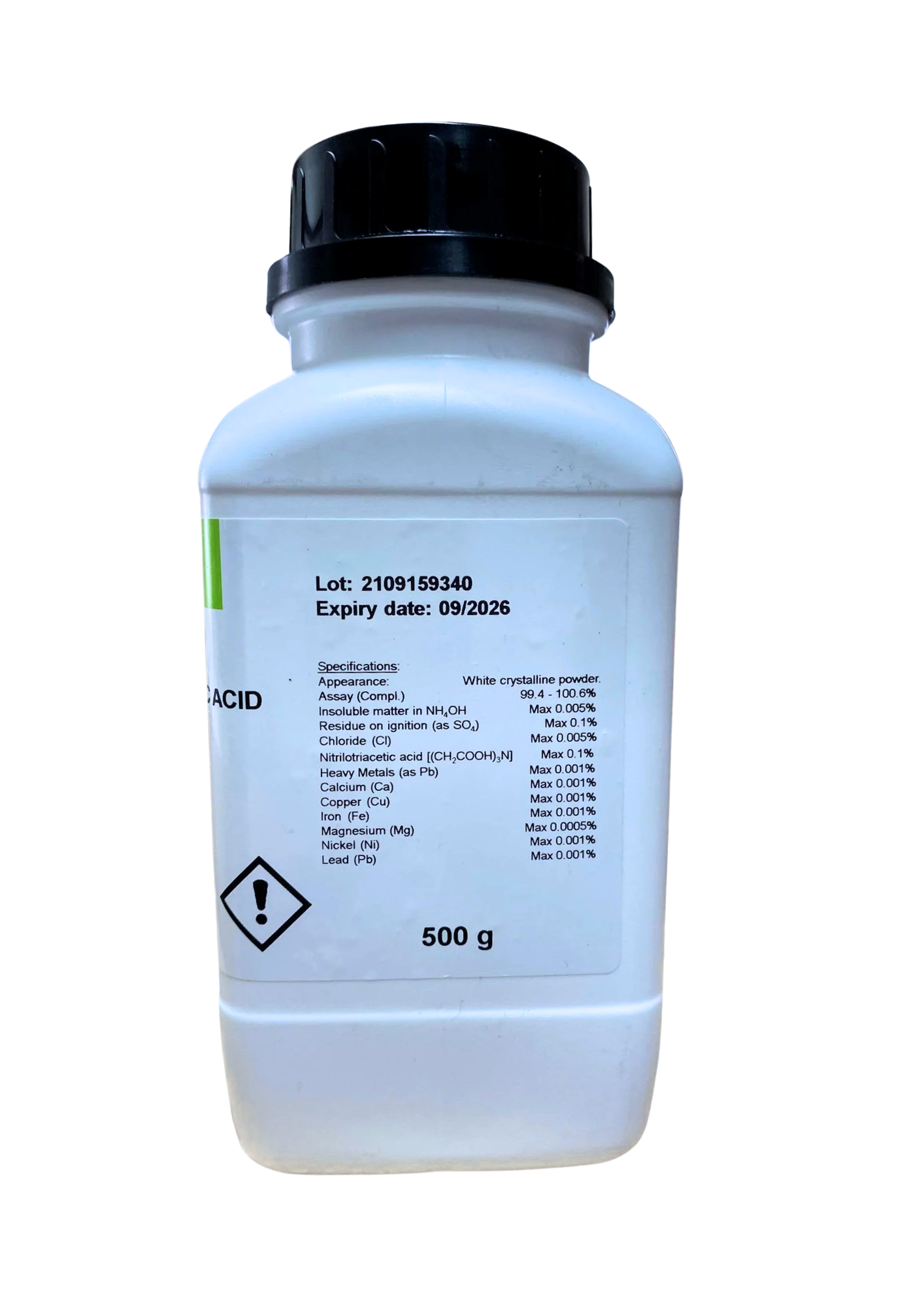
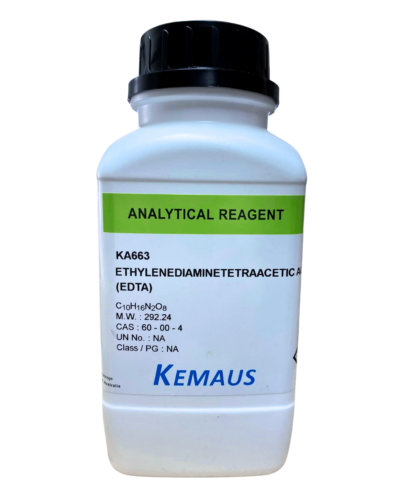
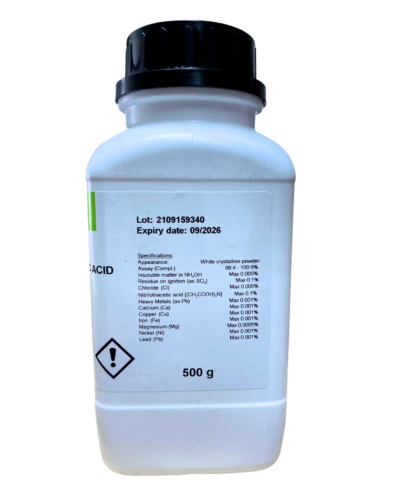
Ethylenediamine Tetraacetic acid
Product Overview & Quality
- Product Name: Ethylenediamine Tetraacetic acid (EDTA / EDTA Free Acid)
- Brand: Kemaus (Product Code: KA-663)
- Grade: Analytical Reagent (AR Grade) with a premium purity of 99.4 percent or higher. Meticulously processed and verified under strict Kemaus laboratory standards, ensuring exceptionally low trace contamination of chlorides, sulfates, and foreign heavy metals. This guarantees an ultra-pure coordination baseline for high-precision quantitative metal binding.
- Physical Properties: Odorless, fine white crystalline powder.
- Solubility: Very slightly soluble in cold water; solubility increases in hot water. Practically insoluble in common organic solvents. Critical Note: It dissolves readily and rapidly in aqueous alkaline solutions (such as by adding sodium hydroxide to adjust the pH baseline).
- Key Use: Heavily utilized as a powerful hexadentate chelating agent (sequestering agent) that complexes with and masks target metal cations (such as calcium, magnesium, iron, and copper) in chemical solutions, effectively preventing metallic interference or unwanted precipitation. Widely used for preparing standard titrant solutions in complexometric titrations, notably water hardness assays. Also heavily applied in biochemistry and molecular biology protocols to deactivate metal-dependent enzymes (e.g., nucleases during DNA extraction), functioning as an effective preservative for nucleic acids.
Safety & Hazards
- Classification: Causes serious eye irritation. Harmful if inhaled (in concentrated dust form). Acts as a mild physical skin and respiratory tract irritant.
- Health Risks: Direct eye contact triggers immediate stinging irritation, painful watering, and localized redness due to its free acid structure. Inhalation of fine airborne dust particles may irritate the upper respiratory tract, inducing coughing or sneezing. Prolonged skin contact can cause minor localized dryness.
- First Aid Measures: Flush eyes or skin immediately with plenty of flowing water for at least 15 minutes. Seek medical evaluation if irritation develops or persists.
Handling & Storage
- Storage: Store in the original, tightly sealed Kemaus container. Keep in a cool, dry, and well-ventilated dedicated chemical safety space at stable room temperature (below 30 degrees Celsius). Chemically highly stable under normal storage settings, but shield from high environmental humidity to prevent caking.
- Precautions: Wear standard personal protective equipment (PPE), including laboratory chemical gloves, safety glasses, and a particulate dust mask. Prevent large dust clouds from building up during daily handling.