
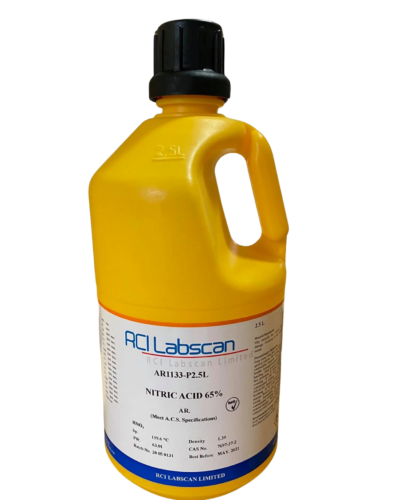
Nitric acid or Aqua fortis
Product Overview & Quality
- Product Name: Nitric acid or Aqua fortis
- Brand: RCI LABSCAN (Product Code: LA-AR1133-P2.5L)
- Grade: Analytical Reagent (AR Grade) featuring a certified premium concentration of 65 percent. Manufactured and quality-verified under RCI LABSCAN strict global laboratory specifications to ensure exceptionally low ppm thresholds of heavy metals, arsenic, iron, chlorides, sulfates, and phosphates. Packaged in a specialized, heavy-duty polyethylene bottle (PE Bottle) to maximize user safety, eliminate transit breakage risks, and prevent silica contamination from glass substrates, ensuring outstanding matrix purity and absolute accuracy for quantitative testing.
- Physical Properties: Clear, colorless to slightly yellowish liquid (due to slow photochemical decomposition releasing nitrogen oxide gases). It is a fuming liquid that emits sharp, intensely pungent and irritating acid vapors when exposed to air, exhibiting aggressive corrosive and powerful oxidizing profiles.
- Solubility: Completely miscible in all proportions with water, liberating significant exothermic thermal energy upon chemical dilution.
- Key Use: Heavily utilized as the definitive primary digestion reagent for decomposing soil, minerals, rocks, plants, food, alloys, and organic samples during sample preparation workflows prior to AAS, ICP-OES, or ICP-MS spectroscopic determination. Commonly applied as a critical acidifying preservative to stabilize environmental water samples and prevent trace metal precipitation. Used to prepare precise laboratory standard acid solutions, and functions as an effective chemical washing fluid for stripping stubborn metal contaminants from high-precision glassware.
Safety & Hazards (Critical & Corrosive)
- Classification: May intensify fire; oxidizer. May be corrosive to metals. Causes severe skin burns and eye damage. Causes serious eye damage. Acute toxicity if inhaled.
- Health Risks: Direct dermal contact triggers immediate severe chemical burns and stains mammalian skin tissue a distinctive dark yellow due to a rapid xanthoproteic reaction with cellular proteins. Direct eye contact causes catastrophic ocular tissue necrosis and permanent blindness. Inhalation of its volatile airborne fumes aggressively corrodes the respiratory tract, inducing violent choking, coughing, throat inflammation, or acute pulmonary edema. Ingestion causes immediate, destructive corrosive destruction to gastrointestinal membranes and stomach perforation.
- First Aid Measures: In case of contact, immediately flush affected eyes or skin with a continuous stream of flowing water for at least 15 minutes while removing contaminated garments. Seek urgent medical emergency evaluation immediately.
Handling & Storage
- Storage: Strong Oxidizer, Highly Corrosive, and Light/Heat Sensitive. Thermal or radiative exposure induces chemical degradation that generates internal gaseous pressure inside closed containers. Must be stored in its original, acid-resistant, tightly sealed RCI LABSCAN PE bottle inside a dedicated corrosive safety storage cabinet with an independent exhaust system. Keep in a cool, dark, and excellently ventilated zone at stable room temperature (below 30 degrees Celsius). Keep completely isolated and separated from flammable liquids, organic solvents (such as ethanol, methanol, acetone), strong bases, metallic powders, and combustible materials (mixing Nitric acid with organic solvents can trigger explosive chemical reactions or spontaneous combustion).
- Precautions: Comprehensive specialized PPE is mandatory, including thick chemical-resistant gloves, splash-proof chemical goggles, a full protective face shield, a chemical-resistant laboratory apron, and an inorganic acid gas respirator mask. Handle exclusively and strictly within a properly functioning laboratory fume hood.