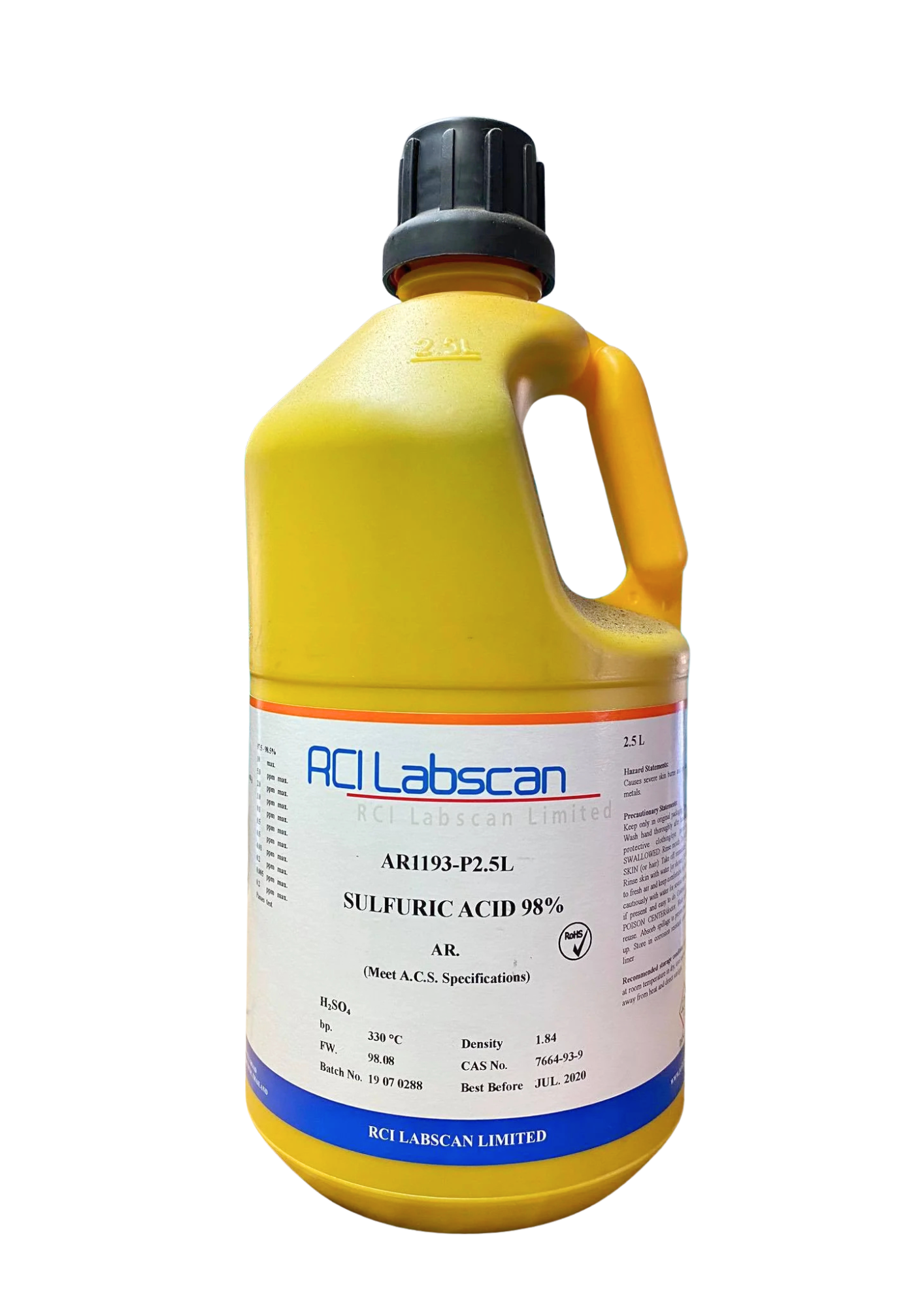
Sulfuric acid or Oil of vitriol
Product Overview & Quality
- Product Name: Sulfuric acid or Oil of vitriol
- Brand: RCI LABSCAN (Product Code: LA-AR1193-P2.5L)
- Grade: Analytical Reagent (AR Grade) featuring a certified premium high concentration of 98 percent. Manufactured and quality-verified under RCI LABSCAN strict global laboratory specifications to ensure exceptionally low ppm thresholds of heavy metals, iron, arsenic, chlorides, nitrates, and ammonium. Packaged in a specialized, heavy-duty polyethylene bottle (PE Bottle) to maximize chemical safety, eliminate transit breakage risks, and prevent silica contamination from glass substrates, ensuring ultimate analytical accuracy.
- Physical Properties: Odorless, clear, colorless, oily, and heavy viscous liquid. It exhibits highly aggressive corrosive profiles and functions as an extremely potent dehydrating agent.
- Solubility & Dilution Rules: Completely miscible with water in all proportions, generating violent exothermic heat upon mixing. Critical Safety Rule: Always add acid to water slowly with continuous stirring; never add water to concentrated acid to prevent explosive chemical splattering.
- Key Use: Heavily utilized as a primary foundational acid to prepare precise volumetric standard solution setups (such as 1.0N or 0.1N Sulfuric acid) for chemical titrations. Widely applied as a critical digestion reagent for decomposing organic compounds, soil, food, and biological samples in Kjeldahl nitrogen determination and pre-spectroscopic sample preparation for AAS or ICP. Commonly used as a catalyst and dehydrating agent in advanced organic chemical synthesis (e.g., esterification reactions), and functions as an effective pH regulator to lower pH profiles in environmental workflows.
Safety & Hazards (Critical & Corrosive)
- Classification: May be corrosive to metals. Causes severe skin burns and eye damage. Causes serious eye damage. Fatal if inhaled.
- Health Risks: Direct tissue or ocular contact triggers immediate, catastrophic chemical burns, deep tissue necrosis, and permanent blindness due to rapid cellular dehydration combined with high thermal energy generation. Inhalation of airborne acid mists or aerosols aggressively damages respiratory tracts and is classified as a human carcinogen, causing severe coughing, choking, or lung injury. Ingestion causes immediate corrosive destruction to gastrointestinal membranes and stomach perforation.
- First Aid Measures: In case of contact, immediately flush affected eyes or skin with a continuous stream of flowing water for at least 15 minutes while removing contaminated garments. Seek urgent medical emergency evaluation immediately.
Handling & Storage
- Storage: Highly Corrosive and Intensely Hygroscopic Acid. It readily absorbs ambient moisture from air, which increases volume and alters concentration baselines. Must be stored in its original, acid-resistant, tightly sealed RCI LABSCAN PE bottle inside a dedicated corrosive safety storage cabinet with proper ventilation. Keep in a cool, dry zone at stable room temperature (below 30 degrees Celsius). Keep strictly isolated from strong bases, organic solvents, combustible materials, metallic powders, and water sources.
- Precautions: Comprehensive specialized PPE is mandatory, including thick acid-resistant chemical gloves, splash-proof chemical goggles, a full protective face shield, a protective lab apron, and an acid mist respirator mask. Handle exclusively and strictly within a properly functioning laboratory fume hood.