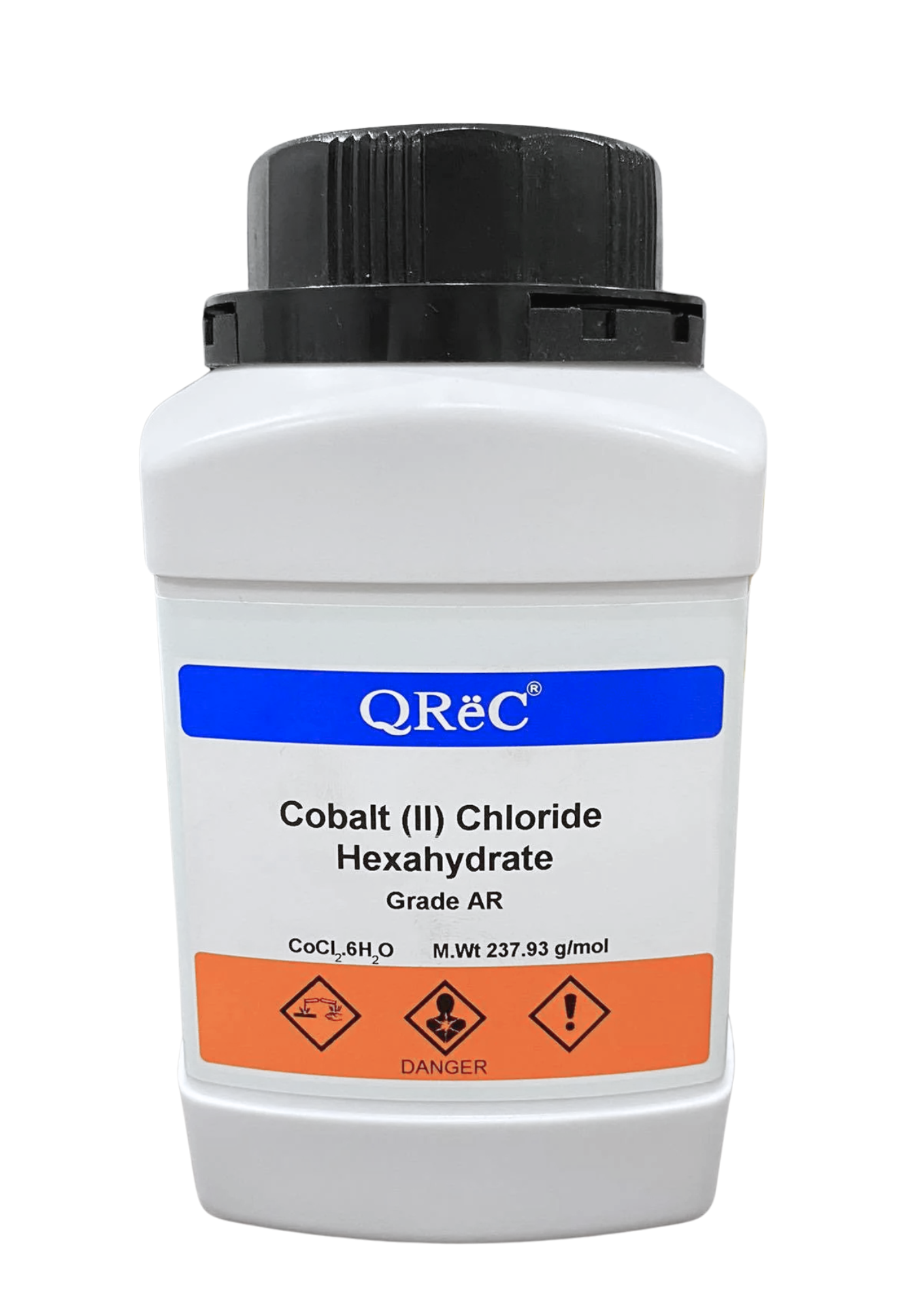
Cobalt (II) chloride 99% or Cobaltous chloride or Cobalt dichloride hexahydrate or Hydrochloric acid cobalt (II) salt
Product Overview & Quality
- Product Name: Cobalt (II) chloride 99% or Cobaltous chloride or Cobalt dichloride hexahydrate or Hydrochloric acid cobalt (II) salt
- Brand: QReC (Product Code: QR-C5002-1-0250)
- Grade: Analytical Reagent High Purity Grade (AR Grade) featuring a certified chemical assay of not less than 99.0 percent in a convenient 250 g laboratory container. Manufactured and multi-crystallized under strict QReC global laboratory specifications, maintaining stoichiometric hexahydrate crystalline integrity. Rigorously tested to enforce minimal water-insoluble matter (strictly below 0.005 percent), alongside ultra-low ppm limits of sulfate, nitrate, ammonium, calcium, magnesium, potassium, sodium, and extraneous heavy metals (such as iron, copper, nickel, lead, zinc, and arsenic). Displays uniform, dry ruby-red crystals that dissolve completely in water to yield crystal-clear, sediment-free pink-red solutions. Packaged in a heavy-duty, moisture-barrier polymer container equipped with an airtight seal to prevent atmospheric hydration shifts and hazardous particulate migration.
- Physical Properties: Deep ruby-red, purplish-red monoclinic crystals or crystalline powder. Odorless. Hygroscopic under ambient atmospheric conditions. Demonstrates iconic thermochromic and moisture-dependent coordination shifts: fully hydrated as a hexahydrate solid it is pink-red, dehydrating through heat to form deep sky-blue anhydrous cobaltous chloride, which reversibly turns pink upon absorbing moisture. Non-combustible inorganic solid. Aqueous solutions are mildly acidic (pH approximately 4.0 to 5.0 for a 5 percent aqueous solution at room temperature).
- Solubility: Readily and highly soluble in water (approximately 76 to 77 grams per 100 milliliters at 20 degrees Celsius, increasing to over 100 grams per 100 milliliters in boiling water, yielding pink solutions); freely soluble in ethanol, methanol, acetone, diethyl ether, and glycerol (solutions in anhydrous organic alcohols turn intensely deep blue due to tetrahedral coordination complex formation).
- Key Use: Universally utilized as a classical humidity indicator in analytical research and industrial desiccants, impregnating moisture-indicating test papers and silica gel beads to visually signify moisture saturation via distinct blue-to-pink color transitions. Widely applied in cell biology and biomedical research as a reliable chemical hypoxia-mimicking agent, artificially stabilizing Hypoxia-Inducible Factor 1-alpha (HIF-1a) to investigate cellular oxygen-sensing pathways and angiogenesis. Serves as a high-purity precursor for synthesizing cobalt coordination complexes, cobalt pigments, and homogeneous/heterogeneous cobalt catalysts in synthetic inorganic chemistry. Employed as an analytical reference standard in spectrophotometric metal assays. Used in electroplating baths and materials science for fabricating cobalt-based nanomaterials.
Safety & Hazards (Critical Carcinogen, Mutagen, Reprotoxic, Respiratory/Skin Sensitizer & Aquatic Hazard)
- Classification: May cause cancer by inhalation (Carcinogenicity Category 1B). May cause genetic defects (Germ Cell Mutagenicity Category 2). May damage fertility (Reproductive Toxicity Category 1B). Harmful if swallowed (Acute Toxicity Oral Category 4). May cause allergy or asthma symptoms or breathing difficulties if inhaled (Respiratory Sensitizer Category 1). May cause an allergic skin reaction (Skin Sensitizer Category 1). Very toxic to aquatic life with long lasting effects (Aquatic Chronic Category 1).
- Health Risks: Direct ocular contact causes transient burning pain, conjunctival redness, corneal irritation, and lacrimation. Dermal contact induces irritation, erythema, dryness, and can trigger severe allergic contact sensitization (cobalt dermatitis). Inhalation of airborne particulate dust aggressively irritates the respiratory tract, causing coughing, sneezing, dyspnea, occupational asthma, and long-term pulmonary fibrosis (hard metal lung disease), with definitive risk of developing respiratory malignancies. Ingestion produces gastrointestinal irritation, epigastric burning pain, vomiting, abdominal cramping, diarrhea, systemic hypotension, thyroid hyperplasia, and severe cardiomyopathy from cumulative cobalt toxicity.
- First Aid Measures: Immediately flush affected eyes with an abundant stream of clean flowing water for at least 15 to 20 minutes while stripping contaminated clothing; remove contact lenses promptly and seek immediate medical care. Wash exposed skin thoroughly with soap and water for at least 15 minutes. In case of dust inhalation, rapidly relocate the victim to fresh air; maintain complete rest and seek prompt medical attention. If accidentally swallowed, rinse mouth thoroughly, administer water in moderate amounts, and seek immediate, urgent emergency medical attention.
Handling & Storage
- Storage: Regulated Carcinogen, Mutagen, Reprotoxic Substance, and Severe Aquatic Pollutant. Must be preserved in its original, tightly closed QReC container placed in secondary containment within a dedicated, locked hazardous chemical safety cabinet. Store in a clean, strictly dry, cool, and well-ventilated dedicated chemical store at controlled temperatures (below 25 degrees Celsius), sheltered from atmospheric humidity and direct sunlight. Keep strictly segregated from reactive metals (such as alkali metals), strong oxidizing agents, strong bases, and foodstuffs.
- Precautions: Comprehensive specialized PPE is mandatory, including chemical-resistant nitrile gloves, splash-proof safety goggles, a certified particulate dust respirator (HEPA / N100 / P100 rated), and a protective lab coat. “Mandatory Handling Mandate: Dispense, weigh, and handle all cobalt chloride powders exclusively and strictly within a certified, properly functioning laboratory fume hood to eliminate airborne particulate dispersal and chronic inhalation. Pregnant or nursing personnel are strictly prohibited from handling this substance.” Never discharge cobalt residues or rinsates into municipal drains; collect exclusively in dedicated toxic heavy-metal waste containers for regulated hazardous disposal.