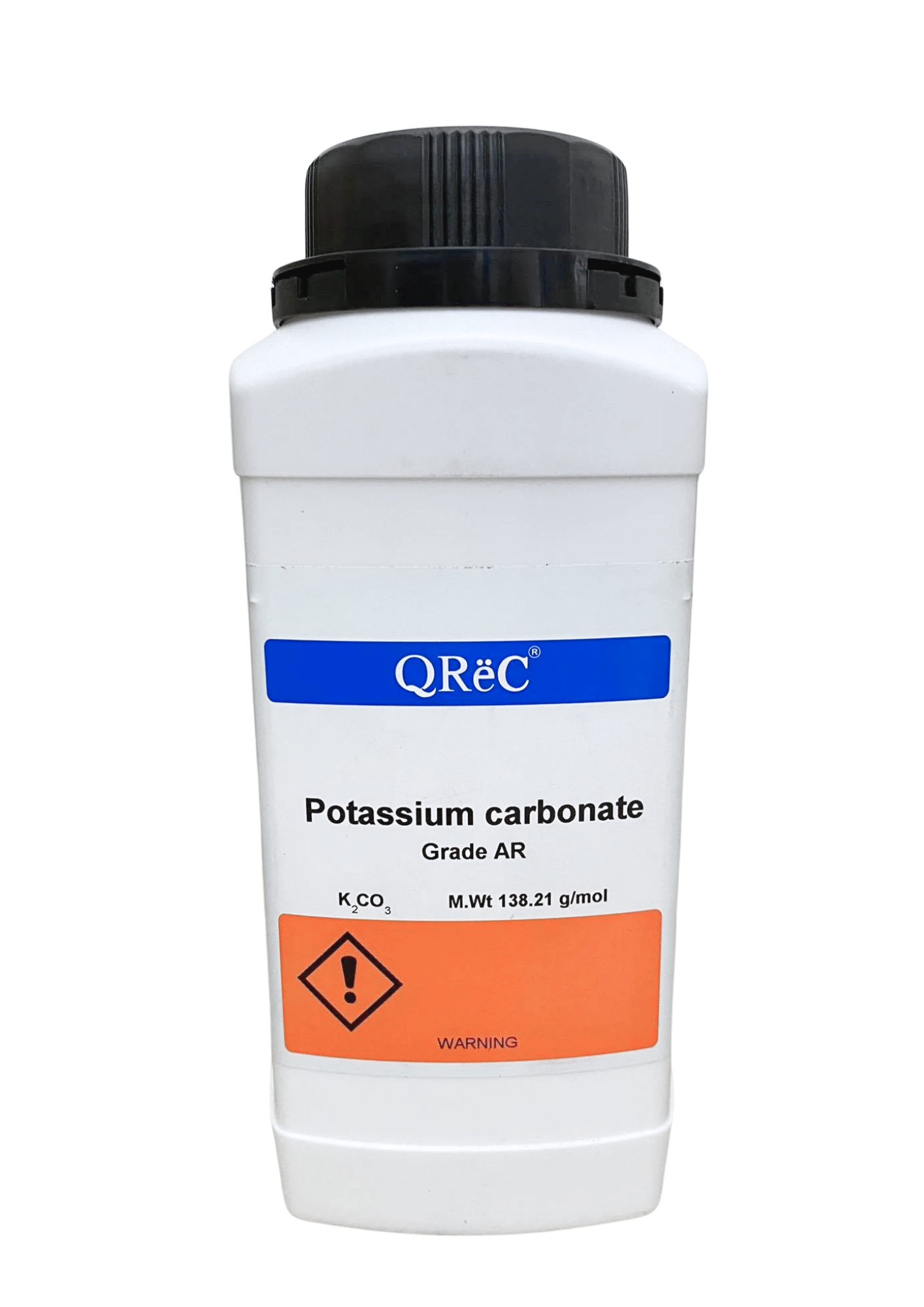
Potassium carbonate 99% or Pearl ash or Potash or Dipotassium carbonate or Salt of tartar
Product Overview & Quality
- Product Name: Potassium carbonate 99% or Pearl ash or Potash or Dipotassium carbonate or Salt of tartar
- Brand: QReC (Product Code: QR-P5048-1-1000)
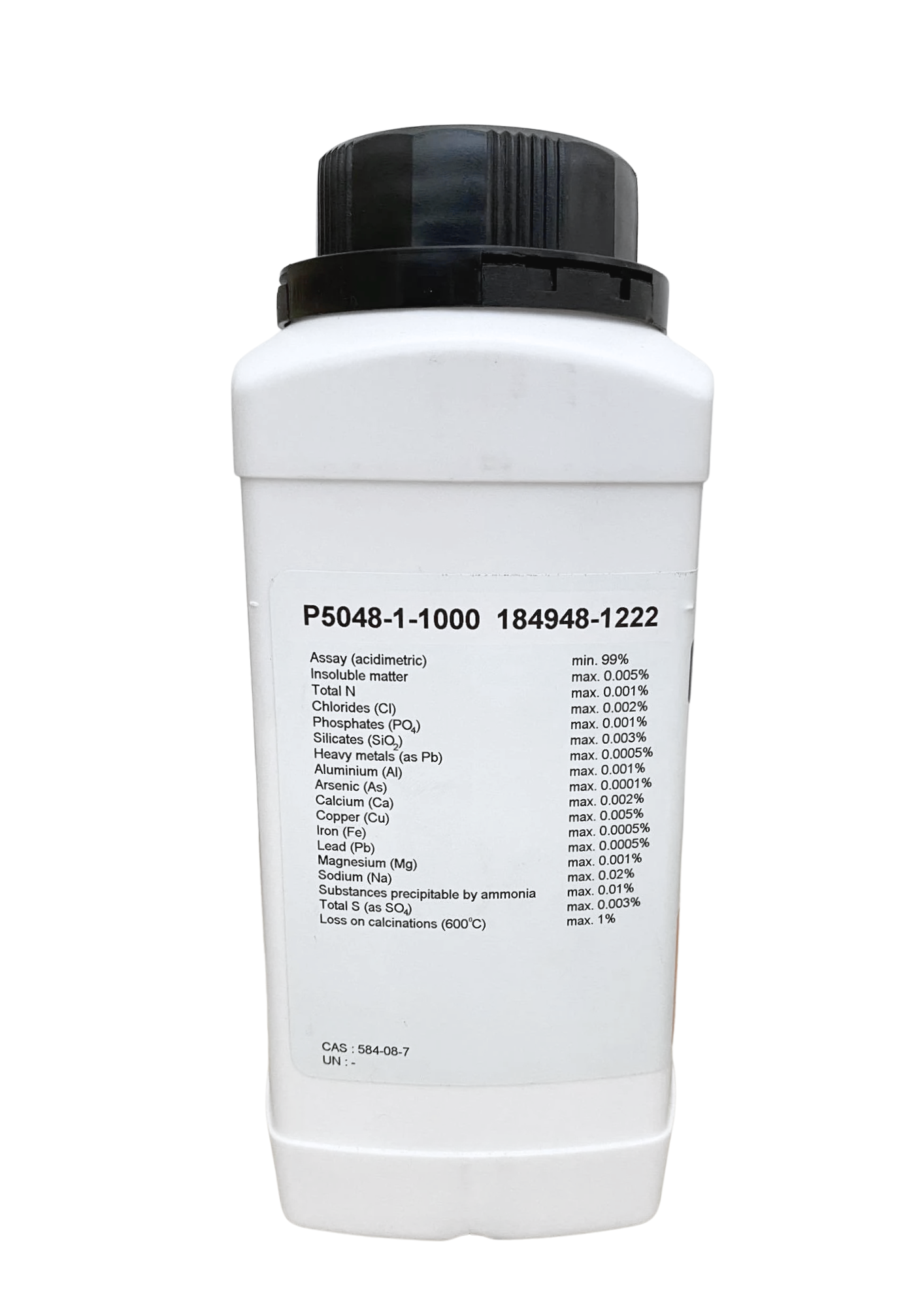
- Grade: Analytical Reagent (AR Grade) featuring a high certified chemical assay of not less than 99.0 percent. Manufactured and calcined under strict QReC global laboratory specifications to ensure low loss on ignition. Rigorously tested to enforce minimal ppm limits of chloride, sulfate, phosphate, silicate, water-insoluble matter, and trace heavy metals (such as iron, lead, copper, arsenic, zinc, calcium, magnesium, and sodium). Displays uniform, dry white crystalline granules that dissolve rapidly and completely in water, producing crystal-clear, strongly alkaline solutions free of insoluble silicates or turbidity. Packaged in a heavy-duty, moisture-barrier polymer container equipped with a hermetic seal to prevent deliquescence.
- Physical Properties: White granular powder or fine white deliquescent crystals. Odorless with an alkaline-saline taste. Highly hygroscopic and deliquescent, rapidly absorbing ambient moisture and carbon dioxide to convert into potassium bicarbonate. Non-combustible inorganic solid. Aqueous solutions are strongly basic (pH approximately 11.5 to 12.0 for a 10 percent aqueous solution at room temperature) and caustic to tissues.
- Solubility: Readily and highly soluble in water (approximately 110 to 112 grams per 100 milliliters at 20 degrees Celsius; dissolution is a pronounced exothermic process releasing heat, with solubility exceeding 150 grams per 100 milliliters in boiling water); soluble in glycerol; practically insoluble in ethanol, methanol, and diethyl ether.
- Key Use: Universally utilized as a mild to moderate inorganic base in synthetic organic chemistry, extensively applied in nucleophilic substitutions, O- and N-alkylations, acylations, and transition-metal catalyzed cross-coupling pathways (such as Suzuki-Miyaura reactions). Heavily used as an inorganic drying agent for desiccating neutral and basic organic solvents, alcohols, ketones, and esters without inducing chemical degradation. Extensively employed in preparing alkaline Carbonate-Bicarbonate Buffer systems (pH 9.2 to 10.8) for biochemical assays and analytical separations. Serves as a standard fusion flux paired with sodium carbonate in analytical mineralogy for dissolving recalcitrant silicates, ores, and refractory geological matrices. Routinely applied as an analytical neutralizing agent and chemical precursor for synthesizing ultra-pure potassium inorganic salts.
Safety & Hazards (Harmful Ingestion, Skin & Severe Eye Irritation)
- Classification: Harmful if swallowed. Causes skin irritation. Causes serious eye irritation. May cause respiratory irritation.
- Health Risks: Aqueous matrices are strongly alkaline. Direct ocular contact triggers acute burning pain, conjunctival redness, corneal irritation, edema, and potential corneal opacification. Dermal exposure strips natural cutaneous lipids, causing caustic irritation, erythema, dryness, and superficial chemical burns upon prolonged contact. Inhalation of particulate dust irritates the mucous membranes of the respiratory tract, inducing coughing, sneezing, sore throat, and dyspnea. Ingestion causes acute irritation and caustic burning of the oral cavity, esophagus, and stomach, accompanied by epigastric pain, nausea, vomiting, abdominal cramping, and diarrhea.
- First Aid Measures: Immediately flush affected eyes with an abundant stream of clean flowing water for at least 15 minutes while stripping contaminated clothing; remove contact lenses promptly and seek medical attention. Wash exposed skin thoroughly with soap and water. In case of dust inhalation, rapidly relocate the victim to fresh air. If accidentally swallowed, do NOT induce vomiting; thoroughly rinse mouth, administer abundant fresh water to dilute the base, and seek prompt medical attention.
Handling & Storage
- Storage: Highly Deliquescent Alkaline Solid. Exposure to atmospheric moisture and carbon dioxide causes rapid liquefaction and carbonation. Must be preserved in its original, tightly closed QReC polymer container. Store in a clean, strictly dry, cool, and well-ventilated dedicated chemical store at controlled temperatures (below 25 to 30 degrees Celsius), sheltered from atmospheric humidity and direct sunlight. Keep strictly segregated from strong mineral acids (contact triggers violent exothermic neutralization accompanied by vigorous effervescence of carbon dioxide gas) and strong oxidizing agents.
- Precautions: Standard laboratory PPE is mandatory, including protective nitrile gloves, splash-proof safety goggles, a certified particulate dust mask, and a protective lab coat. Re-seal container cap tightly immediately after sampling to prevent deliquescent caking. Minimize dust generation during weighing and dispensing.